
15 Best AI SEO Companies 2026, Ranked by the SEO Contextual Density Index
You found this page on Google, or an AI answer sent you here.
That’s the work. We can do the same for your brand.


We read forty-nine results for “ai seo agency” in the United States on September 22, 2026. Only seventeen of them were agency service pages. Eighteen were ranking listicles, four were forum threads, five were software products, three were videos, and the rest were a news column, a press item and a free tool. More than a third of what Google returns for this keyword is people ranking each other, and not one of those rankings showed a reader how the ordering was produced. We wanted a different answer to the same question, so we built a measurable and admittedly partial way to read the on-page SEO of the agency pages an AI SEO buyer actually meets. Our research points to contextual density as the strongest on-page driver we can observe, and that measurement is the core of this index. ProStar SEO publishes its own row here whatever the rank, and the method that produced every number sits on the methodology page.
What the AI SEO market looks like on this keyword
The buyer meets a page that is mostly opinion. Fifteen quality agencies compete in this cohort, drawn from the 15 true service pages inside the first forty-nine results. The anchor keyword draws 3,600 searches a month in the US database at keyword difficulty 28, and the adjacent vocabulary is heavier still: generative engine optimization draws 8,100 and answer engine optimization 4,400. The category is being named faster than it is being defined.
The pages differ far more in breadth than in intensity. Density across the cohort runs from 20.38% to 38.49% and clusters tightly once converted to the pillar, where fourteen of fifteen rows sit between 73 and 80. Coverage runs from 85 distinct list terms to 266, a spread of more than three to one. An AI SEO page separates itself by how much of the market’s vocabulary it carries, not by how hard it presses on one phrase.
Position and page quality disagree openly here. Level Agency holds position two with 189 of the 355 terms, and Coalition Technologies holds position six with 214. Orbit Media ranks at twenty with the thinnest page in the top half of this table. A large site with heavy brand demand ranks a thinner page, which is a fact about domains rather than a fault in either page. This index reads the page and prints the position beside it without scoring it.
The indexAI answersCharacteristicsThe 15 agenciesHow to chooseQuestions to ask
The short version
Top of the index
- 1Thrive Internet Marketing Agency62.8
- 2ProStar SEO62.2
- 3Coalition Technologies61.5
The 15 agencies measured (index rank · live US SERP position, 2026-09-22)
- 1Thrive Internet Marketing Agencypos. 3
- 2ProStar SEO—
- 3Coalition Technologiespos. 6
- 4OuterBoxpos. 8
- 5OMNIUSpos. 15
- 6StudioHawkpos. 34
- 7uSERPpos. 36
- 8Level Agencypos. 2
- 9WebFXpos. 22
- 10Reflect Digitalpos. 37
- 11SimpleTigerpos. 31
- 12SINE Digitalpos. 18
- 13Orbit Media Studiospos. 20
- 14Winston Digital Marketingpos. 30
- 15Notionmindpos. 33
Full tables below: the index (ten columns) and the characteristics (twelve columns), both sortable.
Why this index measures contextual density first
Across the markets we have measured, the pages that rank carry more of the vocabulary a buyer uses than the pages that don’t, and they carry it as a wide set of distinct terms rather than one phrase repeated. Contextual density is that measurement: the share of a page’s words that belong to the market’s term list, read together with how many distinct terms the page covers and how often each one returns. A high reading means the page speaks the market’s language across the whole topic, which is what a search engine and a language model both have to work from. In this market that matters twice, because the engines summarizing these pages are the same engines the pages claim to optimize for.
Read how contextual density is calculatedHow the index scores
Coveragedistinct list terms ÷ 355, as a percentage
Density100 × CD ÷ (CD + 10); this cohort’s median of 31.8% scores 76
Structureshare of the page’s distinct list terms that also appear in the title, H1, H2 or H3
Footprintbranded search volume (US, ceiling 10,000/mo) and Google reviews weighted by rating (ceiling 500), log-scaled, averaged
Efficiency100 × min(1, 3 ÷ repetition index); at or below 3 scores 100
Bars are drawn against the heaviest signal. The five weights sum to 100.
⇅ Sortable tables: click a column header to sort, again to reverse; the # column restores the ranking. Hover a header for the metric’s definition and source.
| # | Agency | Pos. | SCDI | Coverage terms /355 | Density CD % | Efficiency rep. index | Structure placed/distinct | Footprint brand · reviews |
|---|---|---|---|---|---|---|---|---|
| 1 | Thrive Internet Marketing Agency | 3 | 62.8 | 63.1 224 | 75.5 30.76% | 49 6.17 | 36 80/224 | 81.6 1,300 · 259 |
| 2 | ProStar SEO | — | 62.2 | 74.9 266 | 76.1 31.84% | 54 5.60 | 33 88/266 | 44.4 20 · 37 |
| 3 | Coalition Technologies | 6 | 61.5 | 60.3 214 | 75.0 30.02% | 69 4.36 | 15 32/214 | 88.3 4,400 · 252 |
| 4 | OuterBox | 8 | 58.9 | 54.6 194 | 79.2 37.98% | 48 6.22 | 26 51/194 | 82.7 4,400 · 111 |
| 5 | OMNIUS | 15 | 53.7 | 55.5 197 | 74.9 29.82% | 68 4.41 | 27 54/197 | 37.3 30 · no listing |
| 6 | StudioHawk | 34 | 53.5 | 53.2 189 | 76.1 31.83% | 55 5.48 | 14 27/189 | 62.1 110 · 125 |
| 7 | uSERP | 36 | 52.8 | 44.8 159 | 78.9 37.43% | 83 3.60 | 27 43/159 | 44.5 1,300 · 1 |
| 8 | Level Agency | 2 | 51.6 | 53.2 189 | 67.1 20.38% | 54 5.54 | 23 43/189 | 54.0 880 · 11 |
| 9 | WebFX | 22 | 51.3 | 33.8 120 | 73.6 27.88% | 89 3.37 | 8 10/120 | 86.3 6,600 · 205 |
| 10 | Reflect Digital | 37 | 49.8 | 40.0 142 | 75.1 30.19% | 99 3.04 | 16 23/142 | 43.1 30 · 20 |
| 11 | SimpleTiger | 31 | 49.7 | 46.8 166 | 77.8 35.06% | 65 4.61 | 27 45/166 | 32.4 140 · 1 |
| 12 | SINE Digital | 18 | 48.7 | 40.6 144 | 78.7 36.91% | 100 2.92 | 8 12/144 | 36.7 170 · 2 |
| 13 | Orbit Media Studios | 20 | 47.6 | 28.5 101 | 76.3 32.28% | 100 2.53 | 9 9/101 | 64.2 480 · 48 |
| 14 | Winston Digital Marketing | 30 | 46.9 | 36.9 131 | 79.4 38.49% | 64 4.69 | 17 22/131 | 49.0 90 · no listing |
| 15 | Notionmind | 33 | 43.6 | 23.9 85 | 79.1 37.80% | 94 3.19 | 46 39/85 | 12.9 0 · 4 |
Who shows up in AI answers
AI presence here is a countable figure: the number of US keywords for which Google’s AI Overview cites each domain, from the Semrush index on September 23, 2026. Nothing is scored from it; it’s printed because a buyer choosing an SEO agency in Sept wants to know who the machines already quote. Thrive Internet Marketing Agency is cited on 9,172 keywords, OuterBox is cited on 2,356 keywords, ProStar SEO on 127. Bars are log-scaled, so a bar half as long is roughly a count forty times smaller.
Semrush “AI Overview positions”, us database: keywords where the domain appears as a cited source inside the AI Overview. A related figure, keywords the domain ranks for whose SERP carries an AI Overview, runs about ten times higher for every member and is not what’s shown here.
What you’d want to know before calling them
Nothing in this table is scored. It’s the set of facts the ranking pages on this query print about each agency, collected the same way for all fifteen and tagged by source in each column header: stated means the agency says so on its own site and the bracket links to where; public record means Google Maps or Clutch; a measured count comes from the Semrush index on the pull date. Where a fact isn’t public it says so rather than guessing.
| # | Agency | HQ stated | Founded stated | Team stated | Pricing stated | Google rating (n) | Clutch rating (n) | AI SEO vertical | French published | AI Overview citations | Page-1 keywords | Notable clients as stated |
|---|---|---|---|---|---|---|---|---|---|---|---|---|
| 1 | Thrive Internet Marketing Agency | Arlington, Texas [source] | 2005 [source] | 160 employees [source] | $2,500 to $10,000 per month, stated on the measured page [source] | 4.766 (259) | — | yes [source] | none | 9,172 | 34,976 | none named [source] |
| 2 | ProStar SEO | Quebec City, Quebec [source] | 2019 [source] | not listed [source] | not listed [source] | 4.765 (37) | — | yes [source] | none | 127 | 274 | none named [source] |
| 3 | Coalition Technologies | Los Angeles, California [source] | — [source] | 250+ specialists [source] | not listed [source] | 4.8 (252) | — | yes [source] | none | 2,005 | 6,576 | Sugatsune, P3 America, Omni Cheer, GK Elite [source] |
| 4 | OuterBox | Copley, Ohio [source] | 2004 [source] | 300+ specialists [source] | $3,000 to $7,500 stated on the site [source] | 4.9 (111) | — | yes [source] | none | 2,356 | 4,417 | none named [source] |
| 5 | OMNIUS | Europe, stated on the measured page [source] | — [source] | 240+ employees [source] | not listed [source] | no listing | — | yes [source] | none | 67 | 403 | AuthoredUp [source] |
| 6 | StudioHawk | Prahran, Victoria [source] | — [source] | not listed [source] | $3,000 to $4,000 stated on the site [source] | 4.7 (125) | — | yes [source] | none | 332 | 890 | none named [source] |
| 7 | uSERP | Lone Tree, Colorado [source] | — [source] | not listed [source] | $35k referenced on the measured page [source] | 5.0 (1) | — | yes [source] | none | 157 | 323 | none named [source] |
| 8 | Level Agency | Pittsburgh, Pennsylvania [source] | — [source] | not listed [source] | not listed [source] | 4.3 (11) | — | yes [source] | none | 133 | 465 | none named [source] |
| 9 | WebFX | Harrisburg, Pennsylvania [source] | — [source] | not listed [source] | not listed [source] | 4.5 (205) | — | yes [source] | none | 2,175 | 7,460 | IBM [source] |
| 10 | Reflect Digital | Maidstone, Kent [source] | 2011 [source] | not listed [source] | not listed [source] | 5.0 (20) | — | yes [source] | none | 130 | 549 | none named [source] |
| 11 | SimpleTiger | Sarasota, Florida [source] | — [source] | not listed [source] | not listed [source] | 5.0 (1) | — | yes [source] | none | 146 | 275 | none named [source] |
| 12 | SINE Digital | London, United Kingdom [source] | — [source] | not listed [source] | not listed [source] | 5.0 (2) | — | yes [source] | none | 3 | 16 | none named [source] |
| 13 | Orbit Media Studios | Chicago, Illinois [source] | 2001 [source] | 50+ [source] | not listed [source] | 4.9 (48) | — | yes [source] | none | 1,169 | 4,556 | none named [source] |
| 14 | Winston Digital Marketing | Brooklyn, New York [source] | — [source] | not listed [source] | not listed [source] | no listing | — | yes [source] | none | 94 | 343 | none named [source] |
| 15 | Notionmind | Ahmedabad, Gujarat [source] | 2019 [source] | not listed [source] | $5,000 to $15,000 stated on the measured page [source] | 5.0 (4) | — | yes [source] | none | 12 | 40 | none named [source] |
The 15 agencies in detail
One block each, same template, same length, publisher included. Screenshot is the measured page above the fold on the capture date. Facts are the agency’s own statements with the page linked; the measurement sentence is computed from the table above.
1. Thrive Internet Marketing Agency
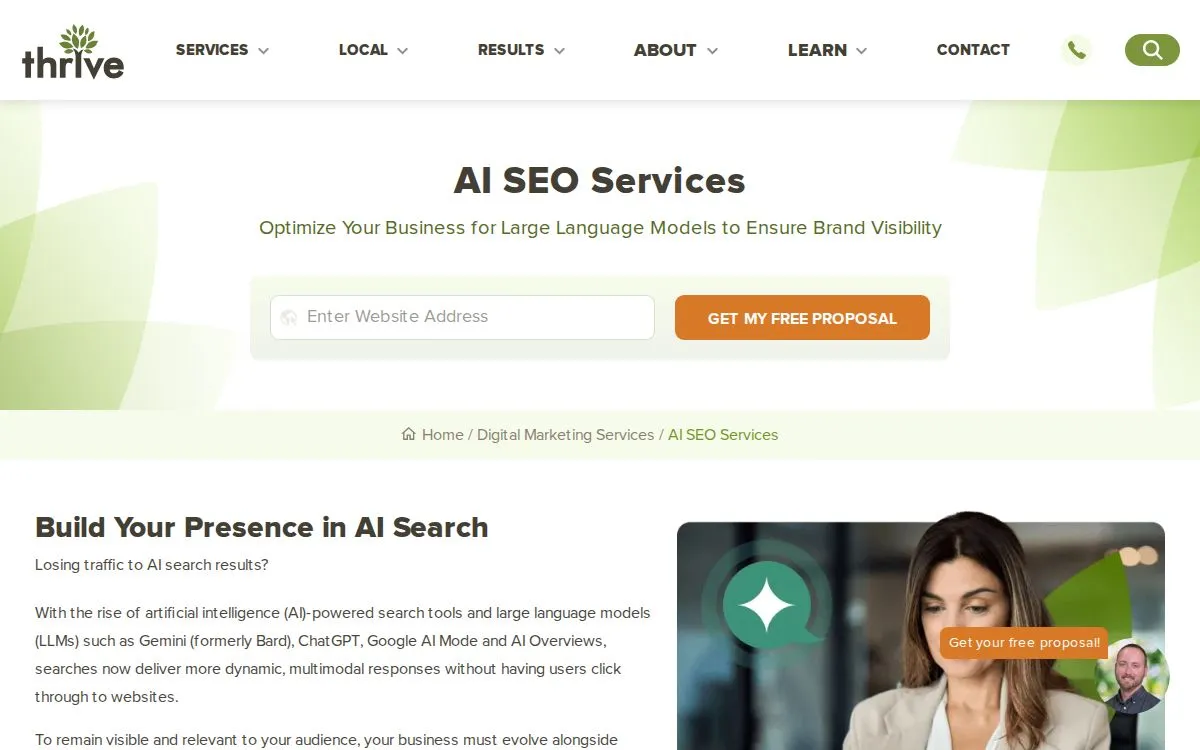
Who they are. A full-service digital marketing agency established in 2005, selling AI SEO as one service line inside a broad offering.
Who they sell to (industries as listed by the agency): ecommerce, enterprise, franchise, healthcare, startups [source].
What the measurement says. The measured page uses 224 of the 355 market terms (63% coverage) over 5,559 words at 30.76% contextual density, repeating each term 6.17 times on average, its strongest pillar is footprint at 82 and its weakest is structure at 36.
What they say about themselves. Services listed: AI SEO, traditional SEO, PPC, web design, social media, email marketing, Amazon marketing [source]. No client names on the site. Pricing: $2,500 to $10,000 per month, stated on the measured page [source]. One quantified claim, verbatim: “a 610% increase in ChatGPT citations, stated on the measured page and not independently verified” [source].
Best for (our reading): a broad marketing program where AI SEO is one line among many.
2. ProStar SEO
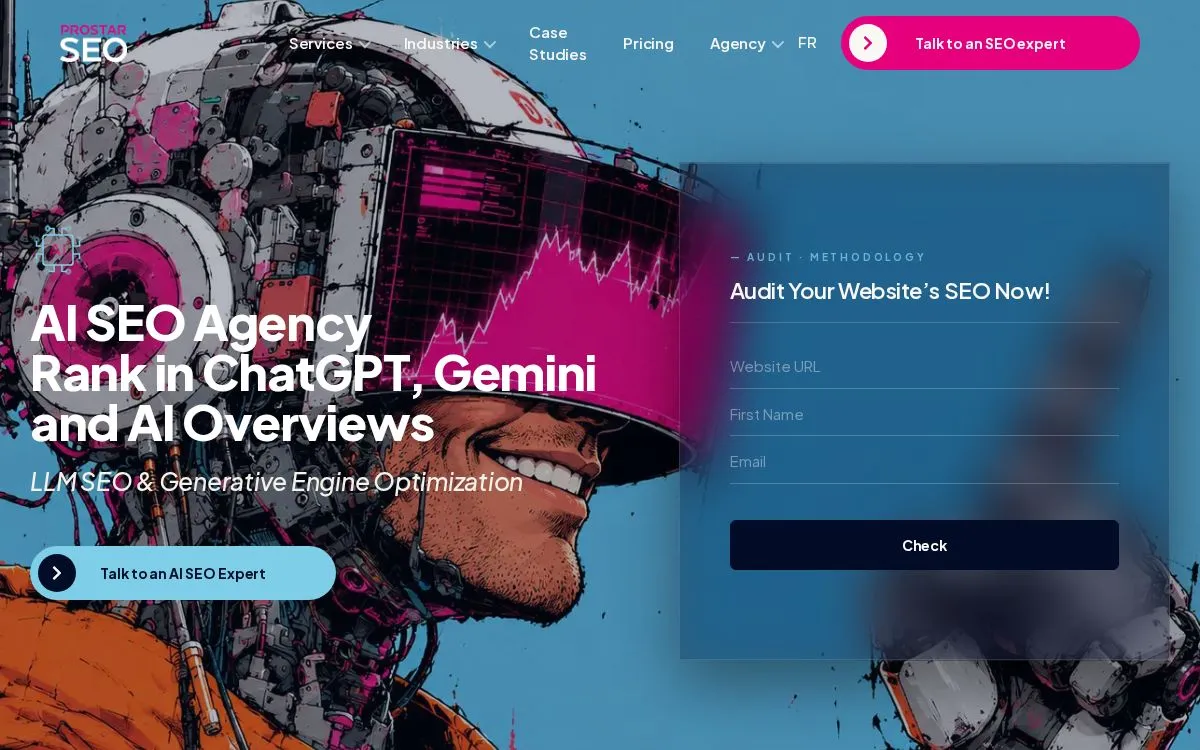
Who they are. A bilingual Canadian SEO agency that publishes the instrument it measures itself with, including on this ranking.
Who they sell to (industries as listed by the agency): automotive, B2B, dental, ecommerce, enterprise, financial services, fintech, franchise, healthcare, legal, manufacturing, real estate, retail, SaaS [source].
What the measurement says. The measured page uses 266 of the 355 market terms (75% coverage) over 6,756 words at 31.84% contextual density, repeating each term 5.60 times on average, ProStar SEO is the publisher of this index and is measured on the same instrument as every other row. Its strongest pillar is coverage at 75, the highest in the cohort, and its weakest is structure at 33, where Thrive places a larger share of its vocabulary in headings than we do. The page was enriched against this list on September 23, 2026, before the measurement was taken, and the list itself was built from the competitor pages with our own page excluded.
What they say about themselves. Services listed: AI SEO, generative engine optimization, answer engine optimization, technical SEO, content, schema and entity work, bilingual English and French [source]. No client names on the site. Pricing: not listed [source]. One quantified claim, verbatim: “a four-model AI visibility study across 38 prompts, published on the measured page with the method and the competitor set named” [source].
Best for (our reading): a buyer who wants the measurement method published before the engagement starts.
3. Coalition Technologies
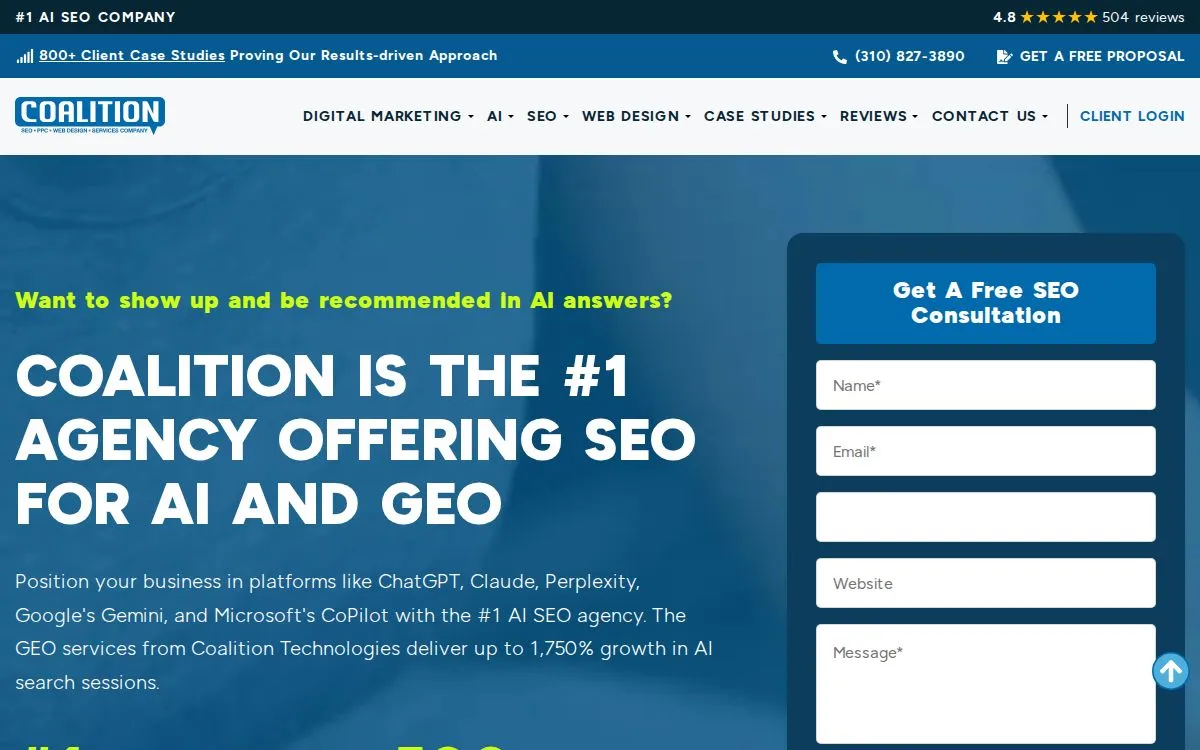
Who they are. A large Los Angeles agency with a wide industry list, selling AI SEO alongside ecommerce build work.
Who they sell to (industries as listed by the agency): B2B, dental, ecommerce, education, enterprise, financial services, healthcare, hospitality, insurance, legal, manufacturing, real estate, SaaS [source].
What the measurement says. The measured page uses 214 of the 355 market terms (60% coverage) over 4,200 words at 30.02% contextual density, repeating each term 4.36 times on average, its strongest pillar is footprint at 88 and its weakest is structure at 15.
What they say about themselves. Services listed: AI SEO and GEO, SEO, PPC, ecommerce design and development, email marketing [source]. Clients named: Sugatsune, P3 America, Omni Cheer, GK Elite [source]. Pricing: not listed [source]. One quantified claim, verbatim: “up to 1,750% growth in AI search sessions, and named client gains of 261.6% and 7,620%, all stated on the measured page and not independently verified” [source].
Best for (our reading): an ecommerce brand that wants AI search work beside build and design capacity.
4. OuterBox

Who they are. An Ohio ecommerce and SEO agency founded in 2004, positioning AI work as AEO and GEO.
Who they sell to (industries as listed by the agency): automotive, B2B, B2C, ecommerce, enterprise, financial services, franchise, healthcare, legal, manufacturing, SaaS [source].
What the measurement says. The measured page uses 194 of the 355 market terms (55% coverage) over 4,329 words at 37.98% contextual density, repeating each term 6.22 times on average, its strongest pillar is footprint at 83 and its weakest is structure at 26.
What they say about themselves. Services listed: AI SEO, AEO and GEO, ecommerce SEO, PPC, web design [source]. No client names on the site. Pricing: $3,000 to $7,500 stated on the site [source].
Best for (our reading): an ecommerce or manufacturing brand buying AEO and GEO from an established shop.
5. OMNIUS
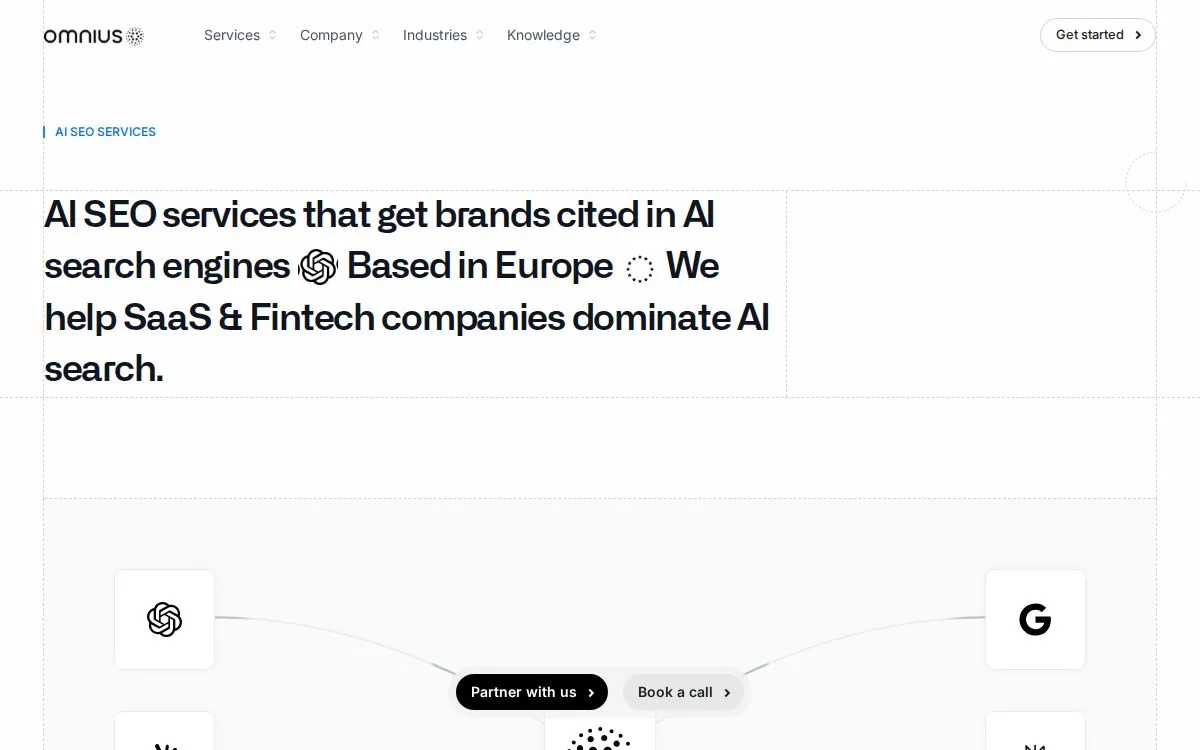
Who they are. A European B2B agency focused on SaaS and fintech, selling AI SEO as citation work.
Who they sell to (industries as listed by the agency): B2B, ecommerce, enterprise, fintech, hospitality, legal, SaaS [source].
What the measurement says. The measured page uses 197 of the 355 market terms (55% coverage) over 3,792 words at 29.82% contextual density, repeating each term 4.41 times on average, its strongest pillar is density at 75 and its weakest is structure at 27, and it sits at position 15 on Google against 5 here, so the page is stronger than the domain carrying it.
What they say about themselves. Services listed: AI SEO, B2B SEO, content, web design [source]. Clients named: AuthoredUp [source]. Pricing: not listed [source]. One quantified claim, verbatim: “64% higher conversion on a new website and 110% organic growth in six months, attributed to a named client contact and not independently verified” [source].
Best for (our reading): a European SaaS or fintech company buying citation work.
6. StudioHawk
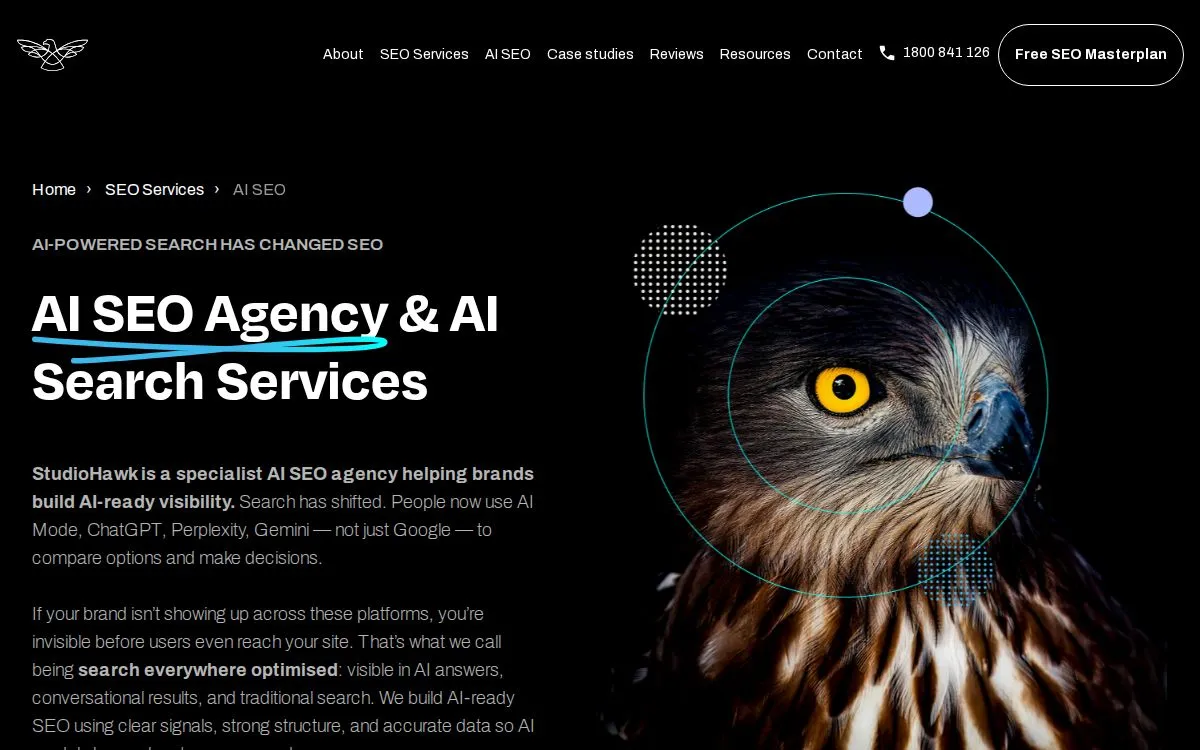
Who they are. An Australian SEO specialist agency, SEO only, with an AI search service line.
Who they sell to (industries as listed by the agency): automotive, B2B, ecommerce, education, enterprise, franchise, healthcare, hospitality, insurance, legal, real estate, retail, SaaS [source].
What the measurement says. The measured page uses 189 of the 355 market terms (53% coverage) over 4,175 words at 31.83% contextual density, repeating each term 5.48 times on average, its strongest pillar is density at 76 and its weakest is structure at 14, and it sits at position 34 on Google against 6 here, so the page is stronger than the domain carrying it.
What they say about themselves. Services listed: AI SEO, technical SEO, local SEO, content, training [source]. No client names on the site. Pricing: $3,000 to $4,000 stated on the site [source]. One quantified claim, verbatim: “a 2000% organic traffic increase for a medical supply site, stated on the measured page and not independently verified” [source].
Best for (our reading): an Australian brand that wants an SEO-only specialist.
7. uSERP
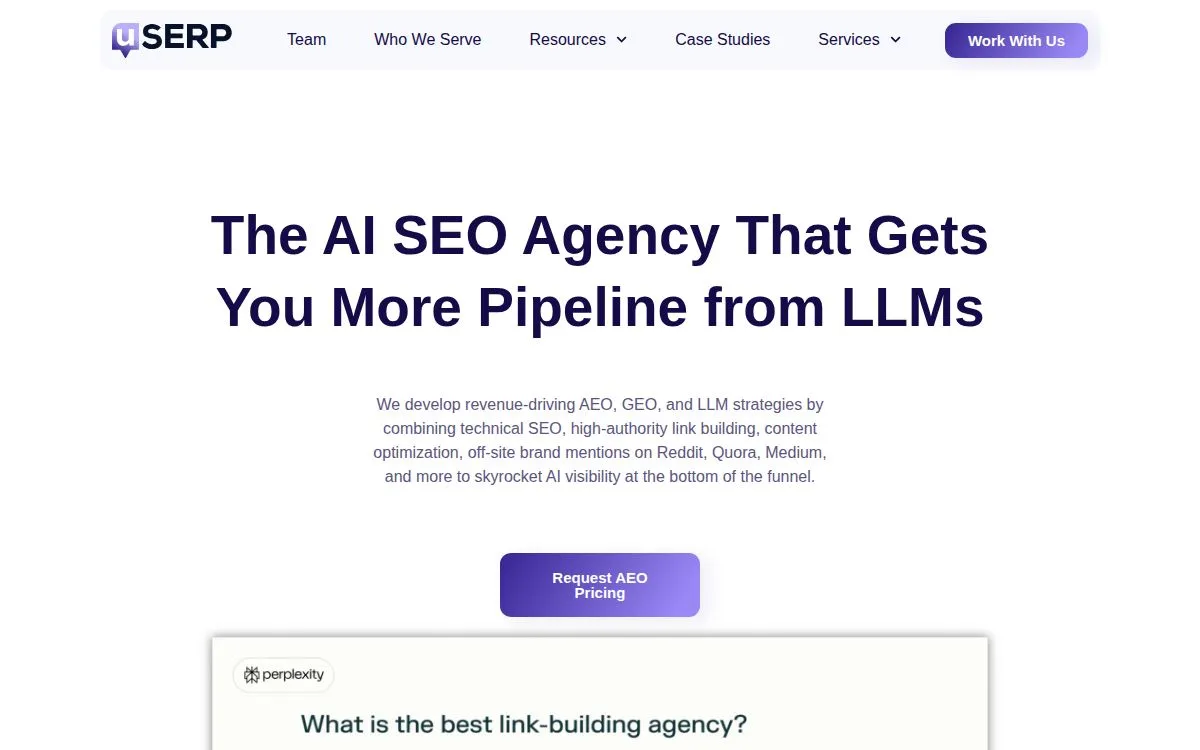
Who they are. A digital PR and link building agency applying authority work to AI visibility.
Who they sell to (industries as listed by the agency): enterprise, healthcare, hospitality, SaaS [source].
What the measurement says. The measured page uses 159 of the 355 market terms (45% coverage) over 2,275 words at 37.43% contextual density, repeating each term 3.60 times on average, its strongest pillar is efficiency at 83 and its weakest is structure at 27, and it sits at position 36 on Google against 7 here, so the page is stronger than the domain carrying it.
What they say about themselves. Services listed: AI SEO, digital PR, link building, content [source]. No client names on the site. Pricing: $35k referenced on the measured page [source].
Best for (our reading): a company whose AI visibility problem is really an authority and digital PR problem.
8. Level Agency
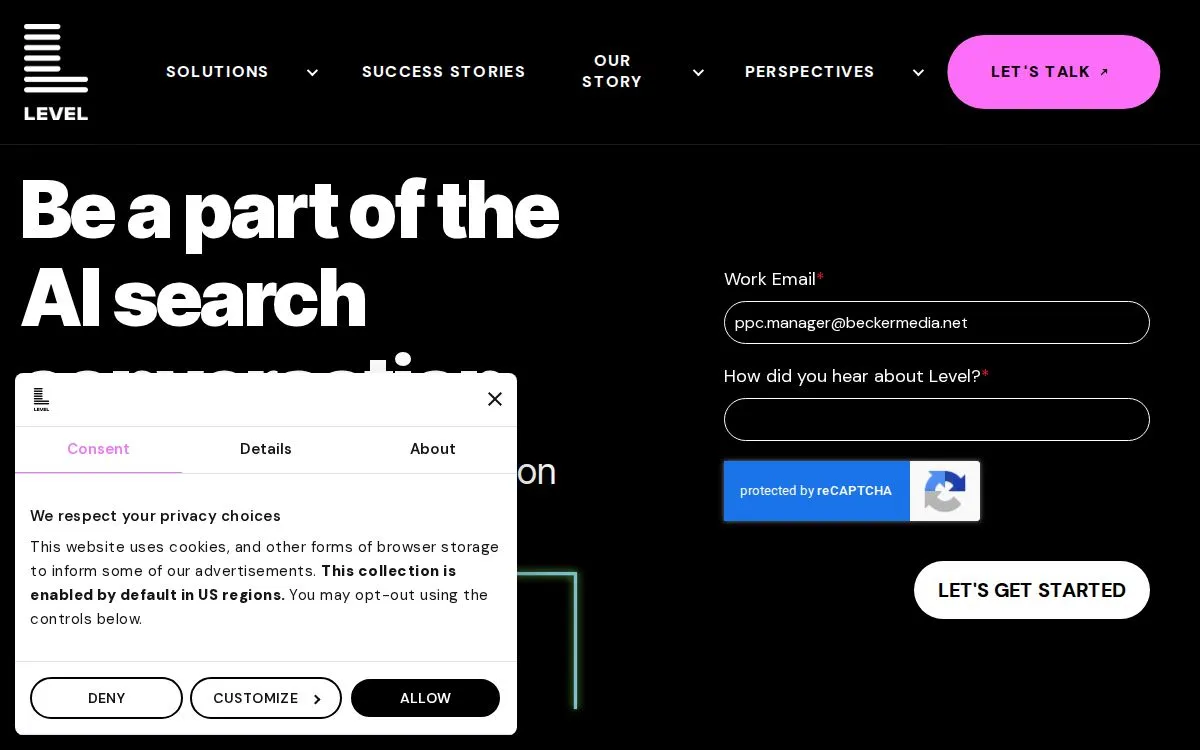
Who they are. A Pittsburgh performance marketing agency with an AI SEO service line.
Who they sell to (industries as listed by the agency): B2B, B2C, education, enterprise, financial services, healthcare [source].
What the measurement says. The measured page uses 189 of the 355 market terms (53% coverage) over 6,970 words at 20.38% contextual density, repeating each term 5.54 times on average, its strongest pillar is density at 67 and its weakest is structure at 23, and it ranks higher on Google (position 2) than on this index (8), which is the domain doing work the page doesn’t.
What they say about themselves. Services listed: AI SEO, performance marketing, paid media, analytics [source]. No client names on the site. Pricing: not listed [source].
Best for (our reading): a performance marketing buyer adding AI search to a paid-heavy program.
9. WebFX
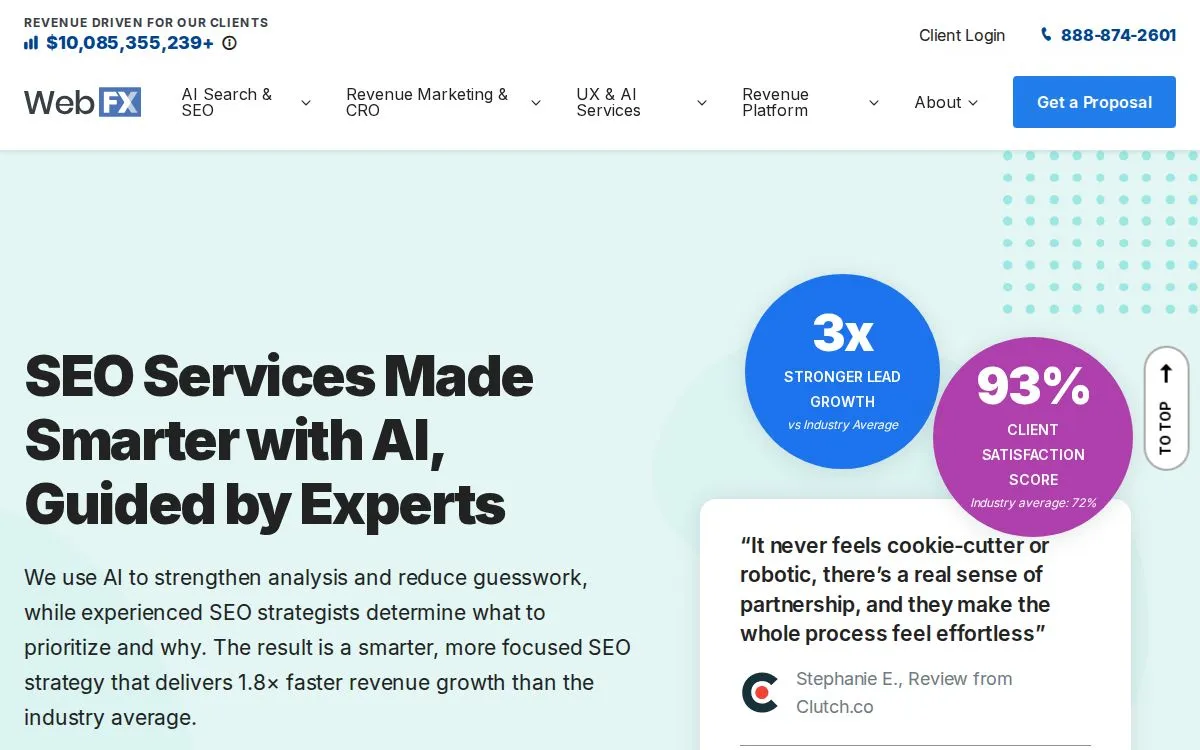
Who they are. A very large Pennsylvania agency whose AI page is about AI-assisted delivery more than AI search visibility.
Who they sell to (industries as listed by the agency): B2B, ecommerce, enterprise [source].
What the measurement says. The measured page uses 120 of the 355 market terms (34% coverage) over 1,807 words at 27.88% contextual density, repeating each term 3.37 times on average, its strongest pillar is efficiency at 89 and its weakest is structure at 8, and it sits at position 22 on Google against 9 here, so the page is stronger than the domain carrying it.
What they say about themselves. Services listed: AI SEO, SEO, PPC, web design, content, a proprietary marketing platform [source]. Clients named: IBM [source]. Pricing: not listed [source]. One quantified claim, verbatim: “WebFX SEO clients grew revenue by 15% or more in the past year, stated on the measured page and not independently verified” [source].
Best for (our reading): a large organization that wants AI-assisted delivery at scale rather than AI search work specifically.
10. Reflect Digital

Who they are. A Kent agency founded in 2011, selling AI search alongside a broad digital offering.
Who they sell to (industries as listed by the agency): B2B, ecommerce, enterprise [source].
What the measurement says. The measured page uses 142 of the 355 market terms (40% coverage) over 2,017 words at 30.19% contextual density, repeating each term 3.04 times on average, its strongest pillar is efficiency at 99 and its weakest is structure at 16, and it sits at position 37 on Google against 10 here, so the page is stronger than the domain carrying it.
What they say about themselves. Services listed: AI search, SEO, paid media, creative, UX [source]. No client names on the site. Pricing: not listed [source].
Best for (our reading): a UK brand wanting AI search inside a full-service relationship.
11. SimpleTiger
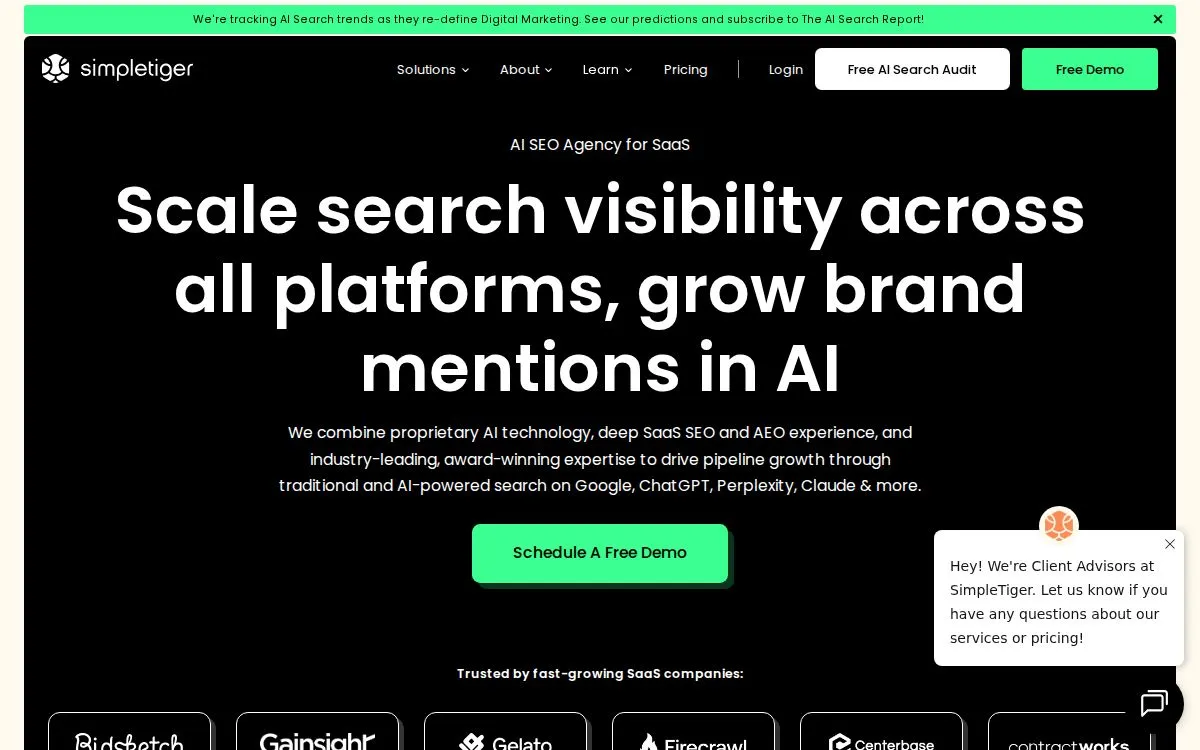
Who they are. A Florida SaaS SEO specialist with an AI SEO page aimed at the same buyer.
Who they sell to (industries as listed by the agency): B2B, B2C, enterprise, fintech, SaaS [source].
What the measurement says. The measured page uses 166 of the 355 market terms (47% coverage) over 2,954 words at 35.06% contextual density, repeating each term 4.61 times on average, its strongest pillar is density at 78 and its weakest is structure at 27, and it sits at position 31 on Google against 11 here, so the page is stronger than the domain carrying it.
What they say about themselves. Services listed: AI SEO, SaaS SEO, keyword research, link building, content [source]. No client names on the site. Pricing: not listed [source].
Best for (our reading): a SaaS company that wants a narrow specialist.
12. SINE Digital
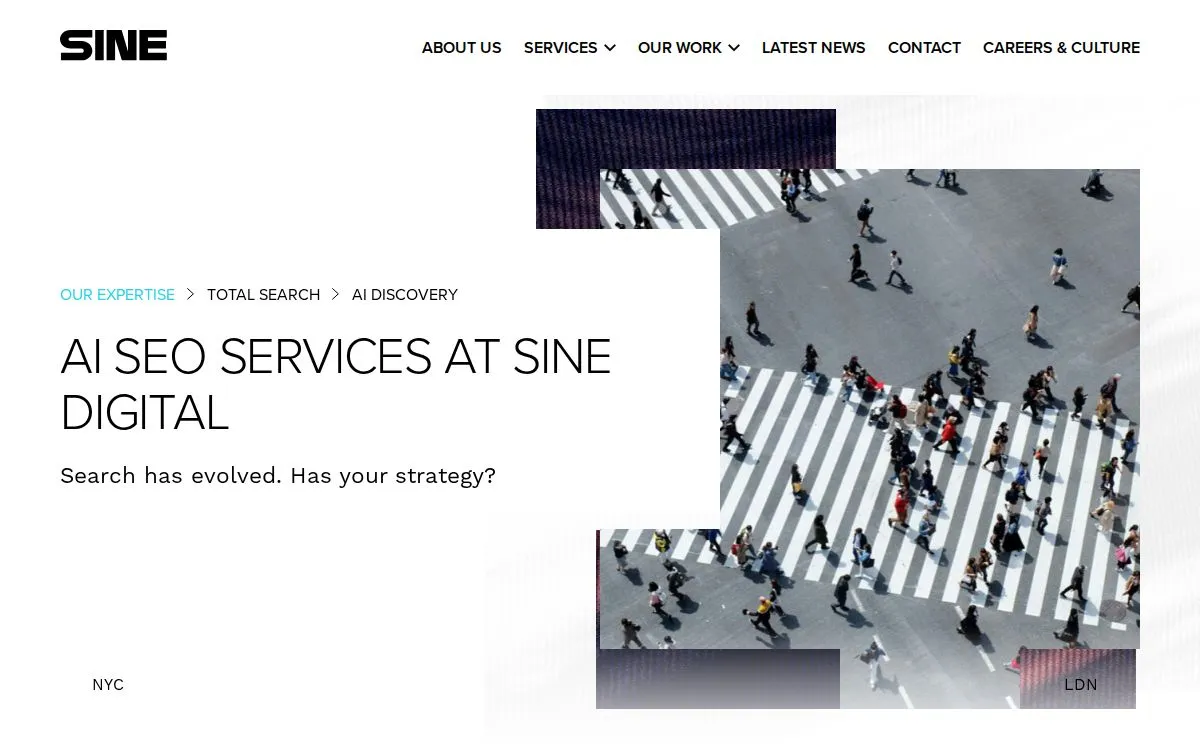
Who they are. A London agency with a New York presence, folding AI SEO into a total search proposition.
Who they sell to (industries as listed by the agency): automotive, ecommerce, hospitality, retail [source].
What the measurement says. The measured page uses 144 of the 355 market terms (41% coverage) over 1,584 words at 36.91% contextual density, repeating each term 2.92 times on average, its strongest pillar is efficiency at 100 and its weakest is structure at 8, and it sits at position 18 on Google against 12 here, so the page is stronger than the domain carrying it.
What they say about themselves. Services listed: AI SEO, GEO, AEO, paid search, total search [source]. No client names on the site. Pricing: not listed [source].
Best for (our reading): a London or New York brand buying AI SEO as part of total search.
13. Orbit Media Studios
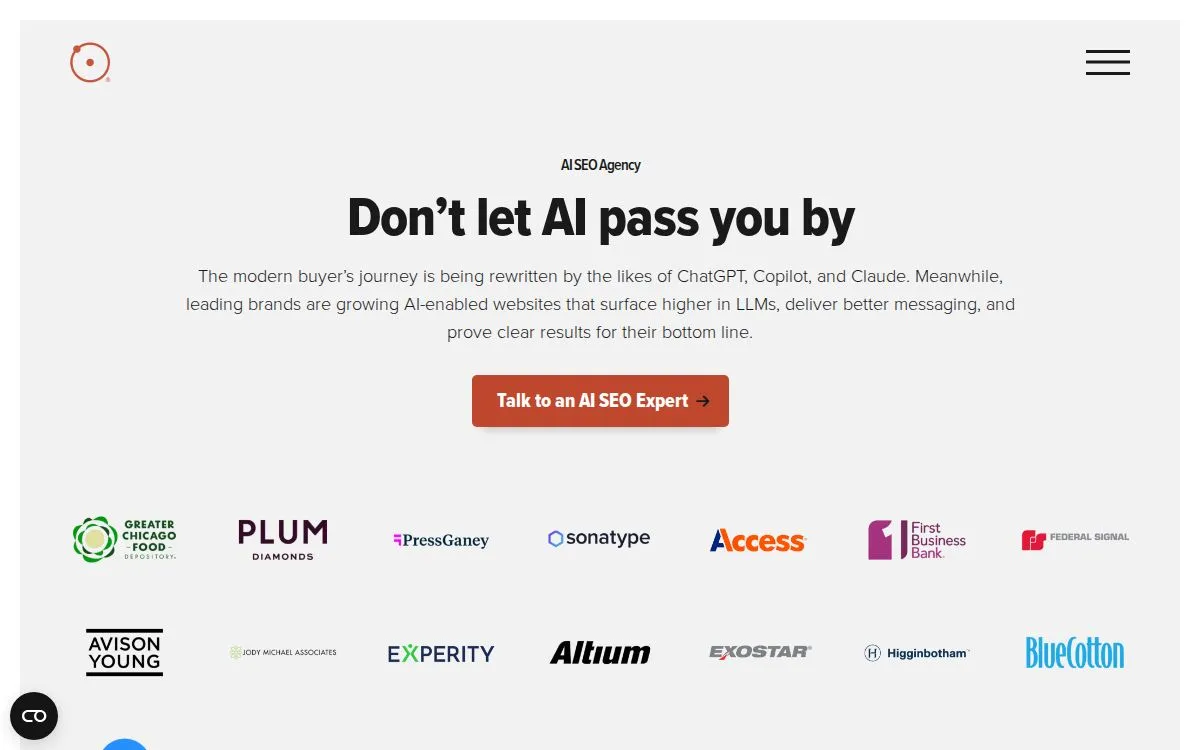
Who they are. A Chicago web design and SEO firm operating since 2001, with a brief AI SEO page.
Who they sell to (industries as listed by the agency): B2B, ecommerce, enterprise, franchise [source].
What the measurement says. The measured page uses 101 of the 355 market terms (28% coverage) over 1,059 words at 32.28% contextual density, repeating each term 2.53 times on average, its strongest pillar is efficiency at 100 and its weakest is structure at 9, and it sits at position 20 on Google against 13 here, so the page is stronger than the domain carrying it.
What they say about themselves. Services listed: AI SEO, SEO, web design and development, analytics [source]. No client names on the site. Pricing: not listed [source]. One quantified claim, verbatim: “a 150% traffic increase attributed to a client testimonial, not independently verified” [source].
Best for (our reading): a Chicago business pairing AI SEO with a website rebuild.
14. Winston Digital Marketing
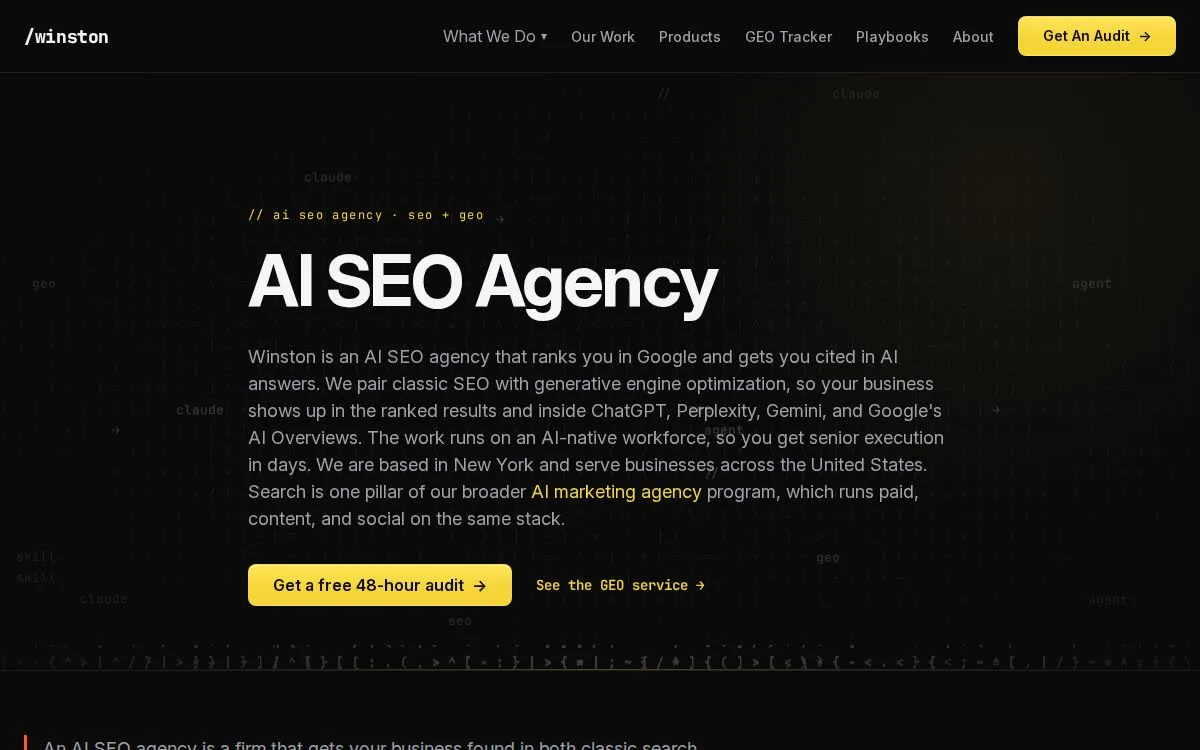
Who they are. A small Brooklyn consultancy led by a named practitioner, selling SEO and GEO together.
Who they sell to (industries as listed by the agency): B2B, dental, ecommerce, healthcare, legal [source].
What the measurement says. The measured page uses 131 of the 355 market terms (37% coverage) over 2,463 words at 38.49% contextual density, repeating each term 4.69 times on average, its strongest pillar is density at 79 and its weakest is structure at 17, and it sits at position 30 on Google against 14 here, so the page is stronger than the domain carrying it.
What they say about themselves. Services listed: AI SEO, GEO, SEO consulting [source]. No client names on the site. Pricing: not listed [source].
Best for (our reading): a small business wanting a named practitioner rather than an account team.
15. Notionmind
Who they are. An Indian firm founded in 2019 that presents as a software company with an SEO service line.
Who they sell to (industries as listed by the agency): enterprise, startups [source].
What the measurement says. The measured page uses 85 of the 355 market terms (24% coverage) over 980 words at 37.80% contextual density, repeating each term 3.19 times on average, its strongest pillar is efficiency at 94 and its weakest is footprint at 13, and it sits at position 33 on Google against 15 here, so the page is stronger than the domain carrying it.
What they say about themselves. Services listed: AI SEO, SEO, software and systems work [source]. No client names on the site. Pricing: $5,000 to $15,000 stated on the measured page [source].
Best for (our reading): a buyer comparing offshore pricing against the rest of this list.
Where the publisher stands
ProStar SEO places second, 0.6 points behind Thrive Internet Marketing Agency. The row is printed at its real rank; closing the gap through coverage alone means covering 5 more of the 355 terms on the published list. Any agency on this table can request a re-measurement; the result is printed, with the date, whatever it shows.
How to choose an AI SEO agency
Ask for the before number. An AI SEO engagement that cannot state what your visibility was on the day it started has no way to prove what it changed, and this is the single fastest way to separate the agencies in this market. A prompt set, an engine list and a baseline reading should exist before any work does.
Ask which engines are measured and how often. ChatGPT, Perplexity, Gemini, Google AI Overviews, Copilot and Meta AI do not share a ranking system, and a single blended visibility percentage hides more than it shows. Separate lines per engine, on a fixed prompt set, run monthly, is the reportable form.
Read the service page itself. This table exists because the page an agency writes about its own AI SEO practice is the cheapest available evidence of how it thinks about the work. Nine of the fifteen pages here carry no client result at all, and four cite third party research about AI search instead of anything they have done.
Questions to ask before hiring
Is AI SEO different from SEO? Partly. The technical foundation is shared: a page that cannot be crawled and parsed cannot be cited. What differs is the target. Traditional SEO earns a ranked link, and AI SEO earns a citation inside a generated answer, which depends more on entity clarity, completeness and repeated topical association than on matching a query.
What do GEO and AEO mean? Generative engine optimization targets the summaries generative engines produce. Answer engine optimization targets short factual answers. Both sit inside what this market calls AI SEO, and most agencies here use the three labels interchangeably.
Why is ProStar SEO on a list it publishes? Because leaving it off would make the index less honest, not more. ProStar is measured on the same instrument as every other row, at whatever rank that produces. It is second in this edition.
Why does the publisher not rank first? Its page scores highest in the market on the four pillars computed from the page itself, and it loses the edition on footprint, which measures branded search demand and Google reviews. That pillar favors the largest firms and ProStar is not one of them.
How often does this change? Positions are re-checked weekly against the live SERP and the full index is recomputed monthly. Every recomputation republishes the table with the date on it.
Reading the table
Read the coverage column first. It carries forty percent of the score because it is the pillar that separates these pages most: the spread runs from 85 terms to 266 against a list of 355. Density, by contrast, is nearly flat once converted to the pillar, so it decides very little here.
The 355-term list was built from the fourteen competitor pages and the Semrush variation set, with the publisher’s own page excluded from the extraction. That rule exists so the publisher cannot cover the list by construction, and it worked: the highest raw coverage in the first measurement belonged to Thrive, not to us. We then enriched our own service page against the finished list before measuring, which is the same move any agency on this table could make from the public list, and which we state here rather than leave a reader to discover.
Where our own row loses: structure, at 33, against Thrive at 36 and NotionMind at 46. We carry more of the market’s vocabulary than anyone and place a smaller share of it in headings than we should. Efficiency at 54 is our second weakness, against Orbit Media and SINE Digital at 100. Both are page problems, both are ours, and both are fixable before the next recomputation.