
15 Best SaaS SEO Companies 2026, Ranked by the SEO Contextual Density Index
We read forty-five results for "saas seo agency" in the United States on 2026-09-23. Fourteen were agency service pages. Twenty-two were ranking listicles, two were buyer guides, two were forum threads, one was a directory, one a LinkedIn profile and one a video. Every listicle named its favorite SaaS SEO agencies and not one showed how the ordering was produced. So we built a measurable and admittedly partial way to read the on-page SEO of the pages a SaaS buyer actually meets. Our research points to contextual density as the strongest on-page driver we can observe. ProStar SEO publishes its own row whatever the rank, and the method behind every number sits on the methodology page.
What the SaaS SEO agency market looks like on this keyword
A SaaS buyer searching this term meets more opinion than offer. Ranking listicles and buyer guides outnumber agency service pages twenty-four to fourteen across the first forty-five results. Fifteen quality SaaS SEO agencies compete inside that depth. The anchor draws 3,600 searches a month in the US database at keyword difficulty 8, the lowest difficulty this index has measured, which is why the listicles crowd it.
The offers behind those pages are not the same product. Some sell SaaS SEO consulting and a technical SEO audit. Some are a SaaS content marketing agency or a b2b content marketing agency with an SEO line. Revv Growth is also a SaaS PPC agency and a demand generation agency, Growfusely leads with digital PR and SaaS link building, Briskon sells enterprise SaaS SEO, and Groie sells product marketing before it sells search visibility. A buyer comparing retainers is often comparing different jobs.
Contextual density across the cohort runs from 12.46% to 29.46% against a 20.1% median, and coverage runs from 52 distinct list terms to 145. A SaaS SEO page separates itself on breadth of vocabulary, not on pressure against one phrase. Position and page quality disagree openly here: SaaS SEO holds position one with 108 of the 307 terms on 1,659 words, while OuterBox sits at position 32 with 143 terms and measures first on the index.
The indexAI answersCharacteristicsThe 15 agenciesHow to chooseQuestions to ask
Why this index measures contextual density before backlinks
Across the markets we have measured, the pages that rank carry more of the vocabulary a buyer uses, and they carry it as a wide set of distinct terms rather than one phrase repeated. Contextual density is that measurement: the share of a page's words belonging to the market's term list, read with how many distinct terms the page covers and how often each returns. It is a data-driven reading of what a page says. Backlinks, brand search and domain age sit outside the page and are not scored here, and this index does not use a vendor domain authority score as an input, because each vendor invents its own and none of them is Google's.
Read how contextual density is calculatedHow the SaaS SEO Contextual Density Index scores
Coveragedistinct list terms ÷ 307, as a percentage
Density100 × CD ÷ (CD + 10); this cohort's median of 20.1% scores 67
Structureshare of the page's distinct list terms that also appear in the title, H1, H2 or H3
Footprintbranded search volume (US, ceiling 10,000/mo) and Google reviews weighted by rating (ceiling 500), log-scaled, averaged
Efficiency100 × min(1, 3 ÷ repetition index); at or below 3 scores 100
Bars are drawn against the heaviest signal. The five weights sum to 100.
⇅ Sortable tables: click a column header to sort, again to reverse; the # column restores the ranking. Hover a header for the metric's definition and source.
| # | Agency | Pos. | SCDI | Coverage terms /307 | Density CD % | Efficiency rep. index | Structure placed/distinct | Footprint brand · reviews |
|---|---|---|---|---|---|---|---|---|
| 1 | ProStar SEO | — | 58.1 | 72.0 221 | 60.6 15.41% | 56 5.35 | 34 76/221 | 43.0 20 · 32 |
| 2 | OuterBox | 32 | 53.4 | 46.6 143 | 68.2 21.44% | 65 4.62 | 15 21/143 | 82.7 4,400 · 111 |
| 3 | Scalerrs | 12 | 49.5 | 38.4 118 | 58.2 13.90% | 86 3.49 | 35 41/118 | 58.1 210 · no listing |
| 4 | SimpleTiger | 29 | 48.3 | 47.2 145 | 63.8 17.60% | 80 3.73 | 25 36/145 | 32.4 140 · 1 |
| 5 | Impression | 9 | 48.0 | 32.9 101 | 65.6 19.10% | 100 2.85 | 26 26/101 | 52.3 30 · 65 |
| 6 | Briskon | 28 | 47.8 | 42.7 131 | 68.3 21.56% | 60 5.02 | 34 44/131 | 40.2 20 · 32 |
| 7 | Nico Digital | 33 | 46.9 | 42.0 129 | 70.4 23.83% | 95 3.16 | 10 13/129 | 33.1 20 · no listing |
| 8 | Revv Growth | 27 | 46.8 | 38.1 117 | 67.8 21.03% | 100 2.97 | 13 15/117 | 40.2 20 · 18 |
| 9 | Stratabeat | 31 | 46.3 | 43.3 133 | 64.9 18.47% | 96 3.12 | 23 30/133 | 20.2 40 · 0 |
| 10 | Sure Oak | 16 | 45.9 | 31.6 97 | 65.6 19.03% | 93 3.23 | 10 10/97 | 61.8 480 · 41 |
| 11 | Virayo | 7 | 45.2 | 35.2 108 | 63.5 17.43% | 100 2.91 | 19 20/108 | 37.3 30 · no listing |
| 12 | Growfusely | 38 | 44.9 | 36.5 112 | 67.9 21.14% | 100 2.81 | 20 22/112 | 25.4 20 · 2 |
| 13 | SaaS SEO | 1 | 39.1 | 35.2 108 | 74.7 29.46% | 85 3.52 | 10 11/108 | 0.0 0 · no listing |
| 14 | SaaS SEO Agency | 2 | 37.3 | 22.8 70 | 73.6 27.82% | 100 2.33 | 23 16/70 | 0.0 0 · no listing |
| 15 | Groie | 20 | 34.4 | 16.9 52 | 55.5 12.46% | 100 1.71 | 27 14/52 | 16.5 20 · 0 |
Which SaaS SEO agencies show up in AI answers
AI presence here is a countable figure: the number of US keywords for which Google's AI Overview cites each domain, from the Semrush index on 2026-09-23. Nothing is scored from it; it's printed because a buyer choosing an SEO agency in 2026 wants to know who the machines already quote. OuterBox is cited on 2,356 keywords, Impression is cited on 332 keywords, ProStar SEO on 127. Bars are log-scaled, so a bar half as long is roughly a count forty times smaller.
Semrush "AI Overview positions", us database: keywords where the domain appears as a cited source inside the AI Overview. A related figure, keywords the domain ranks for whose SERP carries an AI Overview, runs about ten times higher for every member and is not what's shown here.
What to know before calling a SaaS SEO company
Nothing in this table is scored. It's the set of facts the ranking pages on this query print about each agency, collected the same way for all fifteen and tagged by source in each column header: stated means the agency says so on its own site and the bracket links to where; public record means Google Maps or Clutch; a measured count comes from the Semrush index on the pull date. Where a fact isn't public it says so rather than guessing.
| # | Agency | HQ stated | Founded stated | Team stated | Pricing stated | Google rating (n) | Clutch rating (n) | SaaS vertical | French published | AI Overview citations | Page-1 keywords | Notable clients as stated |
|---|---|---|---|---|---|---|---|---|---|---|---|---|
| 1 | ProStar SEO | Montreal, Quebec [source] | 2019 [source] | — [source] | not published [source] | 4.7 (32) | — | page only [source] | full site [source] | 127 | 274 | none named [source] |
| 2 | OuterBox | Akron, OH [source] | 2004 [source] | 300+ digital marketing and web experts [source] | publishes market rates of $100-$250 an hour, $3,000-$7,500… [source] | 4.9 (111) | — | page only [source] | none [source] | 2,356 | 4,417 | 1 EDI Source [source] |
| 3 | Scalerrs | — [source] | — [source] | — [source] | not published [source] | no listing | — | yes [source] | none [source] | 45 | 235 | Innoloft, Marq [source] |
| 4 | SimpleTiger | Sarasota, FL [source] | — [source] | — [source] | states a good SEO agency runs $5,000 to $30,000+ a month… [source] | 5.0 (1) | — | yes [source] | none [source] | 146 | 275 | none named [source] |
| 5 | Impression | Nottingham, with London [source] | — [source] | — [source] | not published [source] | 5.0 (65) | — | page only [source] | none [source] | 332 | 937 | none named [source] |
| 6 | Briskon | Bangalore, India [source] | 2005 [source] | — [source] | SaaS SEO engagements start at $3,999 a month [source] | 4.2 (32) | — | page only [source] | none [source] | 68 | 146 | none named [source] |
| 7 | Nico Digital | — [source] | — [source] | — [source] | custom-scoped engagement, no figure published [source] | no listing | — | yes [source] | none [source] | 16 | 26 | none named [source] |
| 8 | Revv Growth | Dover, DE [source] | — [source] | — [source] | monthly retainer at $3,000 a month, plus one-time strategy… [source] | 5.0 (18) | — | yes [source] | none [source] | 70 | 170 | Atlan [source] |
| 9 | Stratabeat | Burlington, MA [source] | — [source] | — [source] | no figure [source] | 0.0 (0) | — | yes [source] | none [source] | 11 | 70 | none named [source] |
| 10 | Sure Oak | Brooklyn, NY [source] | — [source] | — [source] | not published [source] | 4.7 (41) | — | page only [source] | none [source] | 201 | 707 | none named [source] |
| 11 | Virayo | — [source] | 2018 [source] | — [source] | states a minimum of $7,500 a month for at least six months [source] | no listing | — | yes [source] | none [source] | 27 | 74 | ForUsAll [source] |
| 12 | Growfusely | — [source] | — [source] | — [source] | a done-for-you monthly SEO retainer, no figure published [source] | 5.0 (2) | — | yes [source] | none [source] | 4 | 114 | Mind the Graph [source] |
| 13 | SaaS SEO | Farmers Branch, TX [source] | — [source] | — [source] | not published [source] | no listing | — | yes [source] | none [source] | 7 | 13 | HubSpot, Zapier, Monday.com [source] |
| 14 | SaaS SEO Agency | — [source] | — [source] | — [source] | published tiers at $1,000 and $3,000 a month, billed monthly [source] | no listing | — | yes [source] | none [source] | 1 | 0 | none named [source] |
| 15 | Groie | Austin, TX [source] | — [source] | — [source] | no figure [source] | 0.0 (0) | — | yes [source] | none [source] | 4 | 20 | none named [source] |
The 15 SaaS SEO agencies in detail
One block each, same template, same length, publisher included. Screenshot is the measured page above the fold on the capture date. Facts are the agency's own statements with the page linked; the measurement sentence is computed from the table above.
1. ProStar SEO
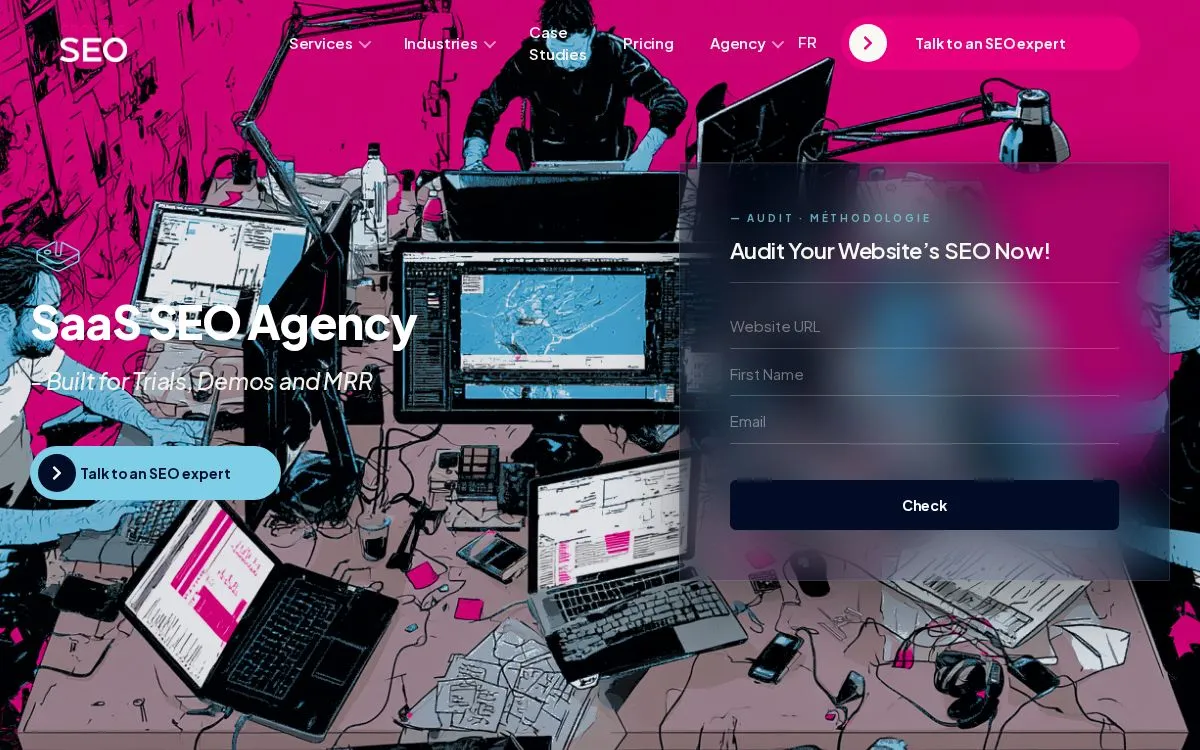
Who they are. The publisher of this index. ProStar SEO runs technical SEO, site architecture, crawlability and indexation work before content, then writes the integration pages, comparison pages, alternative pages and pricing pages that move SaaS buyers from search intent to demo requests and trial signups. Content is scored against a measured contextual density benchmark rather than a word count, in English and French, and the agency publishes its own row here at whatever rank the measurement gives it. [source]
Who they sell to (industries as listed by the agency): SaaS, cannabis, casino, adult, plastic surgery, legal, dental, healthcare [source].
What the measurement says. The measured page uses 221 of the 307 market terms (72% coverage) over 10,546 words at 15.41% contextual density, repeating each term 5.35 times on average, which is the widest vocabulary in the cohort and 76 of those terms reach a title or a heading. The list was built from the competitor pages and from Semrush without reference to this page, so the figure is a measurement rather than a ceiling. Two things sit against this row. The footprint pillar is where it loses: 20 United States brand searches a month and 32 Google reviews across two readable listings put it behind every large agency here. And the section you are reading sits on the page it scores, so its own vocabulary counts toward the reading; the figure is printed after a live re-measure of the published page, not before.
What they say about themselves. Services listed: technical SEO audit, site architecture and crawlability, internal linking, product-led SEO content, integration, comparison and pricing pages, AI search visibility, SEO in English and French [source]. No client names on the site. Pricing: not published [source].
Best for (our reading): B2B SaaS companies that want technical SEO, site architecture and crawlability fixed first, then integration, comparison and pricing pages written against a measured contextual density benchmark, in English or French.
2. OuterBox
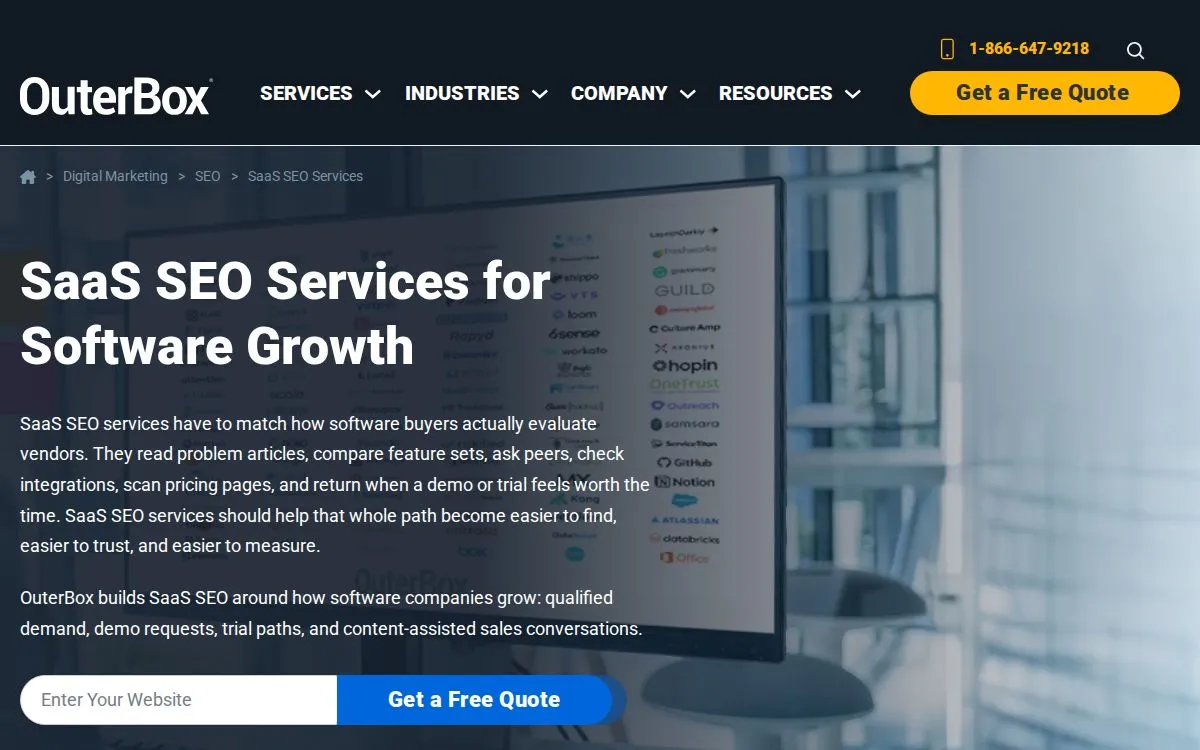
Who they are. The oldest agency in the cohort by its own account, working in SEO since 2004. The page is the second widest in coverage at 143 terms and is unusually direct about what SEO costs. [source]
Who they sell to (industries as listed by the agency): SaaS, ecommerce, lead generation [source].
What the measurement says. The measured page uses 143 of the 307 market terms (47% coverage) over 4,066 words at 21.44% contextual density, repeating each term 4.62 times on average, its strongest pillar is footprint at 83 and its weakest is structure at 15, and it sits at position 32 on Google against 2 here, so the page is stronger than the domain carrying it.
What they say about themselves. Services listed: SaaS technical SEO for marketing site, app paths and docs, buyer-journey content, authority signals, CRO and UX, revenue reporting [source]. Clients named: 1 EDI Source [source]. Pricing: publishes market rates of $100-$250 an hour, $3,000-$7,500 a month for most US agencies, and up to $50,000 for project work [source]. One quantified claim, verbatim: “1 EDI Source organic conversions +57% year over year in the first full month, organic leads +66% month over month, keyword rankings +70%” [source].
Best for (our reading): SaaS companies whose marketing site, app paths and docs need crawlability, indexation and Core Web Vitals fixed before any content strategy ships.
3. Scalerrs
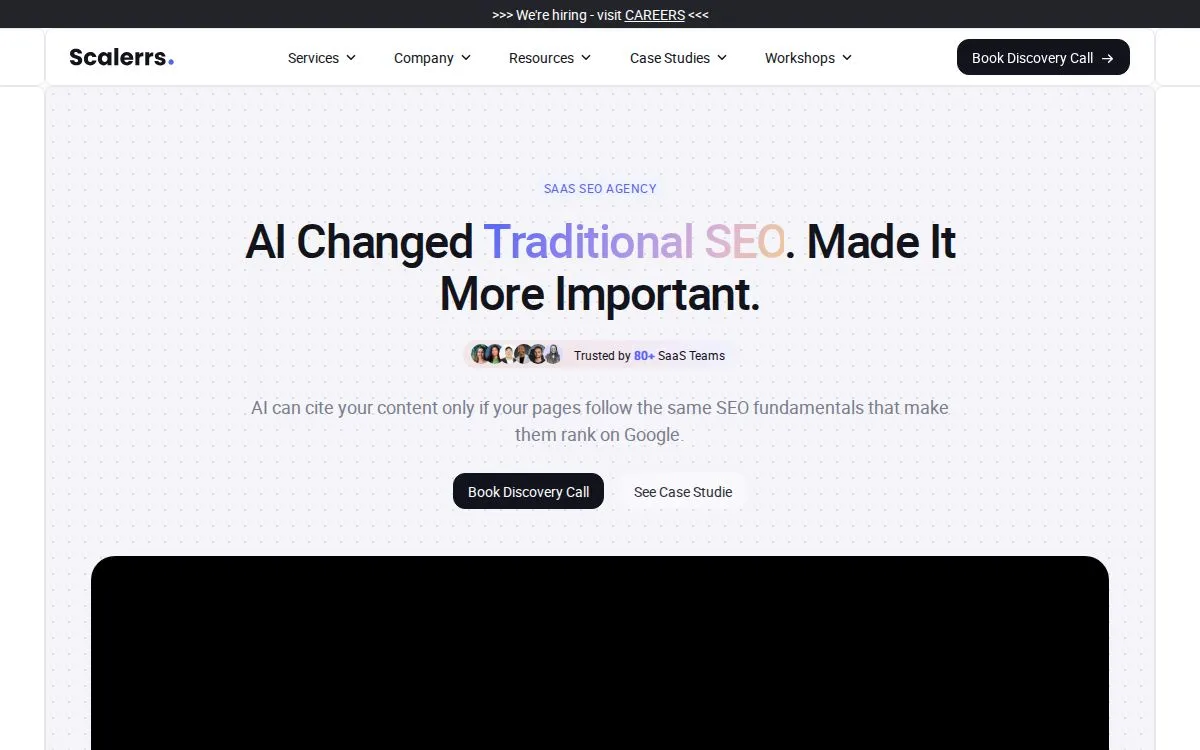
Who they are. An answer-engine-first agency. The page leads with an AEO workshop and ships templates and UI kits for comparison pages, so the offer is as much productised assets as retained service. [source]
Who they sell to (industries as listed by the agency): B2B SaaS [source].
What the measurement says. The measured page uses 118 of the 307 market terms (38% coverage) over 4,138 words at 13.90% contextual density, repeating each term 3.49 times on average, its strongest pillar is efficiency at 86 and its weakest is structure at 35, and it sits at position 12 on Google against 3 here, so the page is stronger than the domain carrying it.
What they say about themselves. Services listed: SEO and AEO, comparison and alternative pages, Reddit, CRM enrichment [source]. Clients named: Innoloft, Marq [source]. Pricing: not published [source]. One quantified claim, verbatim: “over $300K in pipeline in a month from AEO and SEO; a client pipeline doubled from $740K; 3-5x LLM citations” [source].
Best for (our reading): B2B SaaS teams whose priority is generative engine optimization and winning comparison and alternative searches at high-intent search intent.
4. SimpleTiger
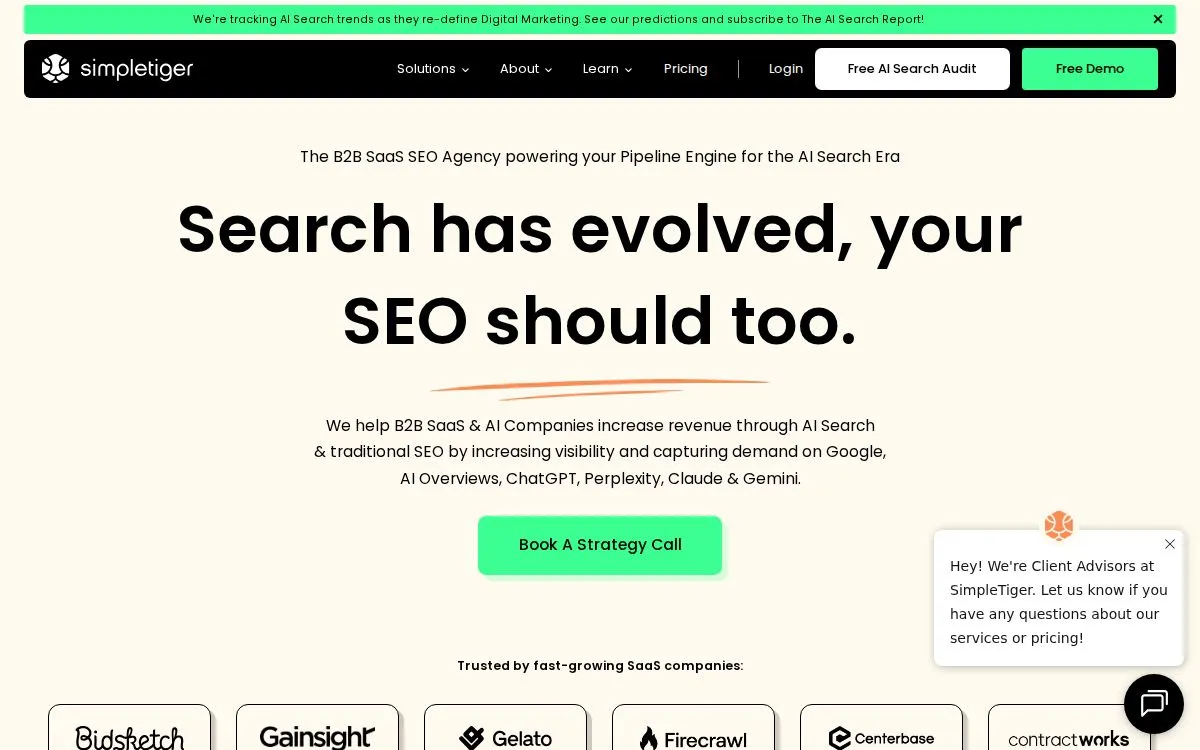
Who they are. A SaaS-only agency with the widest term coverage in the cohort at 145 of 307. It publishes a price range on the page, which most of this cohort does not, and treats AI search as a named service line. [source]
Who they sell to (industries as listed by the agency): B2B and B2C SaaS, from solo-founder seed stage to category leaders [source].
What the measurement says. The measured page uses 145 of the 307 market terms (47% coverage) over 4,611 words at 17.60% contextual density, repeating each term 3.73 times on average, its strongest pillar is efficiency at 80 and its weakest is structure at 25, and it sits at position 29 on Google against 4 here, so the page is stronger than the domain carrying it.
What they say about themselves. Services listed: SEO and AEO research, content, technical optimization, authority link building, Reddit and community, AI search [source]. No client names on the site. Pricing: states a good SEO agency runs $5,000 to $30,000+ a month depending on size and competition [source]. One quantified claim, verbatim: “#1 in AI Search across 459 tracked customer-success competitors; +231% direct traffic growth against baseline; over $672,000 in attributed ARR from one campaign” [source].
Best for (our reading): B2B and B2C SaaS companies at any stage that want SaaS link building, technical optimization and AI search visibility as named deliverables.
5. Impression
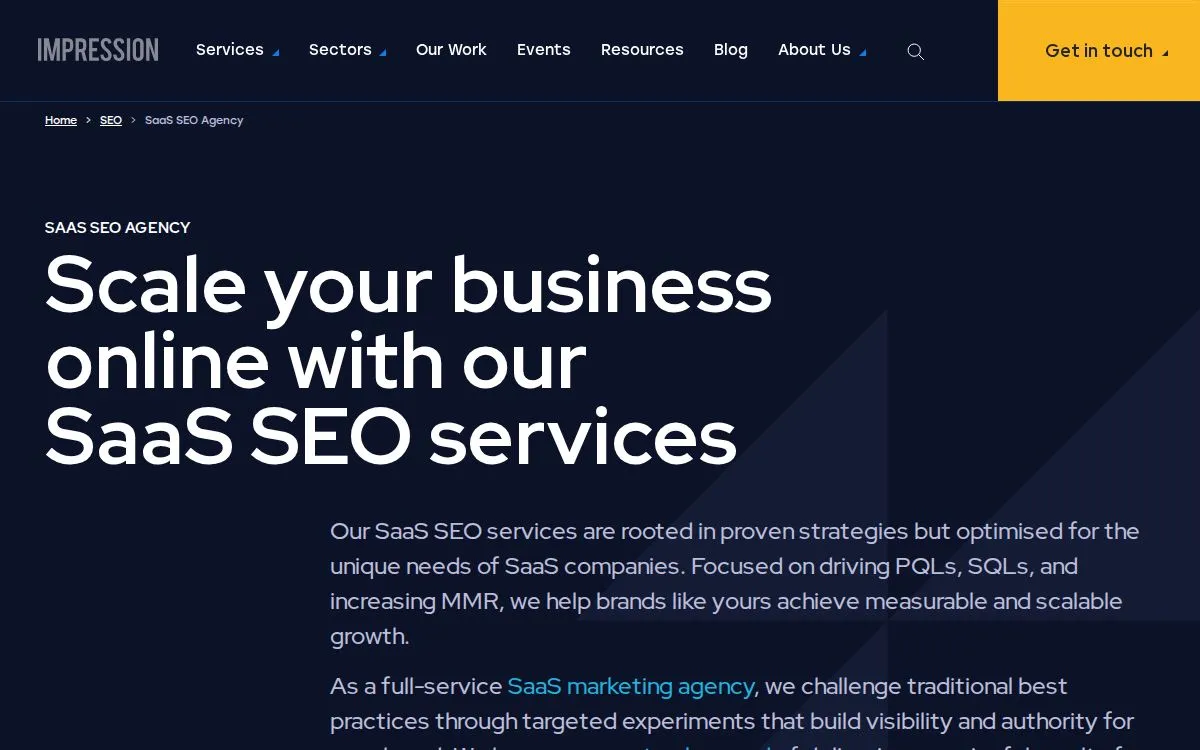
Who they are. A UK full-service digital agency with a SaaS service line. The largest organic footprint in the cohort at 7,781 US keywords, and the page reads as one vertical inside a wider offer. [source]
Who they sell to (industries as listed by the agency): SaaS, as one vertical inside a broader client base [source].
What the measurement says. The measured page uses 101 of the 307 market terms (33% coverage) over 2,186 words at 19.10% contextual density, repeating each term 2.85 times on average, its strongest pillar is efficiency at 100 and its weakest is structure at 26.
What they say about themselves. Services listed: SaaS keyword strategy, product-led content, continual testing and optimization [source]. No client names on the site. Pricing: not published [source]. One quantified claim, verbatim: “24% increase in organic conversions for a management automation client” [source].
Best for (our reading): SaaS brands wanting a full-service agency where SaaS SEO sits beside paid campaigns, content creation and conversion rate work.
6. Briskon
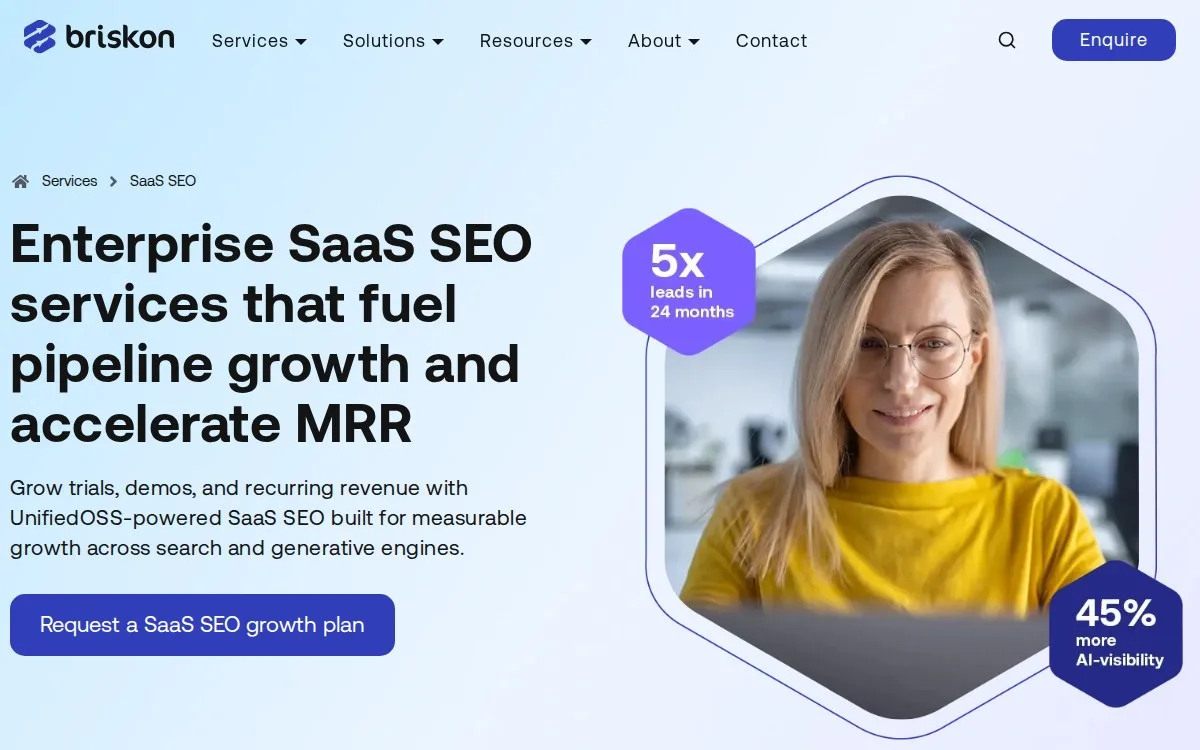
Who they are. An Indian technology firm that states it serves 150+ clients globally. The SaaS page is built around AI discovery and lifecycle expansion, and it carries the highest repetition index in the cohort at 5.02. [source]
Who they sell to (industries as listed by the agency): SaaS, real estate and others named in the case studies [source].
What the measurement says. The measured page uses 131 of the 307 market terms (43% coverage) over 3,816 words at 21.56% contextual density, repeating each term 5.02 times on average, its strongest pillar is density at 68 and its weakest is structure at 34, and it sits at position 28 on Google against 6 here, so the page is stronger than the domain carrying it.
What they say about themselves. Services listed: product-led keyword discovery, comparison and alternatives pages, conversion-focused SEO and CRO, AI answer visibility, lifecycle expansion SEO [source]. No client names on the site. Pricing: SaaS SEO engagements start at $3,999 a month [source]. One quantified claim, verbatim: “2,750+ high-intent leads, 56% lower ad costs and a 6,483% visibility surge for a real estate client” [source].
Best for (our reading): enterprise SaaS SEO buyers wanting lifecycle and comparison-page coverage, conversion rate work and a published starting investment.
7. Nico Digital
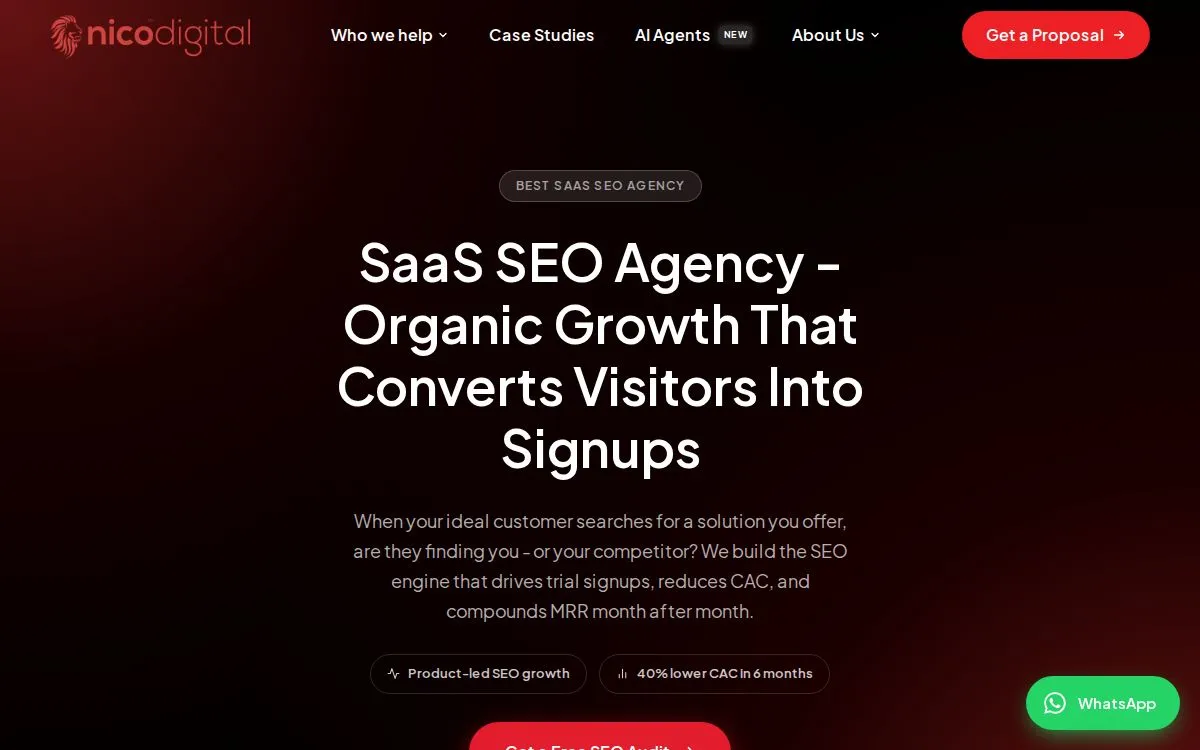
Who they are. A SaaS page built almost entirely around before-and-after numbers. It carries the highest density in the cohort outside the two homepages, at 23.83%, on 129 distinct terms. [source]
Who they sell to (industries as listed by the agency): SaaS and B2B, with clients stated across India, the US, UK, EU and APAC [source].
What the measurement says. The measured page uses 129 of the 307 market terms (42% coverage) over 2,311 words at 23.83% contextual density, repeating each term 3.16 times on average, its strongest pillar is efficiency at 95 and its weakest is structure at 10, and it sits at position 33 on Google against 7 here, so the page is stronger than the domain carrying it.
What they say about themselves. Services listed: SaaS keyword research, technical SEO, content, a seven-step strategy [source]. No client names on the site. Pricing: custom-scoped engagement, no figure published [source]. One quantified claim, verbatim: “CAC from $280 to $168, organic trials from 40 to 215 a month and page-one keywords from 12 to 148 in six months; 2X average MRR increase from organic; 187% growth in organic trial signups; 2,400+ high-intent keywords ranked” [source].
Best for (our reading): SaaS teams that judge a SaaS SEO agency on before-and-after CAC, organic trial signups and page-one keyword counts.
8. Revv Growth
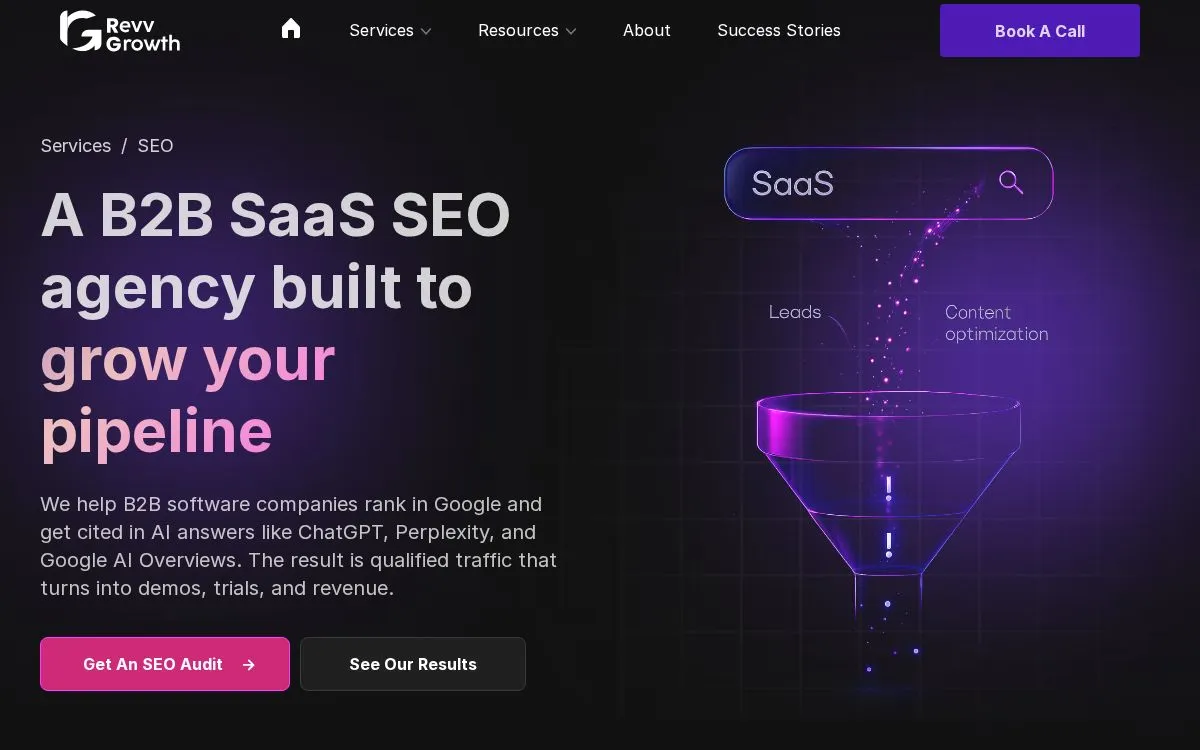
Who they are. A full-funnel B2B SaaS marketing agency where SEO is one of nine service lines. The page reports on pipeline rather than rankings and publishes its retainer openly. [source]
Who they sell to (industries as listed by the agency): B2B SaaS [source].
What the measurement says. The measured page uses 117 of the 307 market terms (38% coverage) over 2,221 words at 21.03% contextual density, repeating each term 2.97 times on average, its strongest pillar is efficiency at 100 and its weakest is structure at 13, and it sits at position 27 on Google against 8 here, so the page is stronger than the domain carrying it.
What they say about themselves. Services listed: demand generation, content marketing, SEO, PPC, ABM, AI SEO, GEO, AEO, product marketing [source]. Clients named: Atlan [source]. Pricing: monthly retainer at $3,000 a month, plus one-time strategy and audit options [source]. One quantified claim, verbatim: “Atlan 858% increase in organic traffic, 17,277 to 163,000, and 258% increase in top 3 rankings; a client went from 10 to 47 monthly qualified leads on a $4,000 budget” [source].
Best for (our reading): B2B SaaS teams buying demand generation whole, where SEO sits beside a SaaS PPC agency offer, ABM and product marketing, reported on pipeline impact.
9. Stratabeat
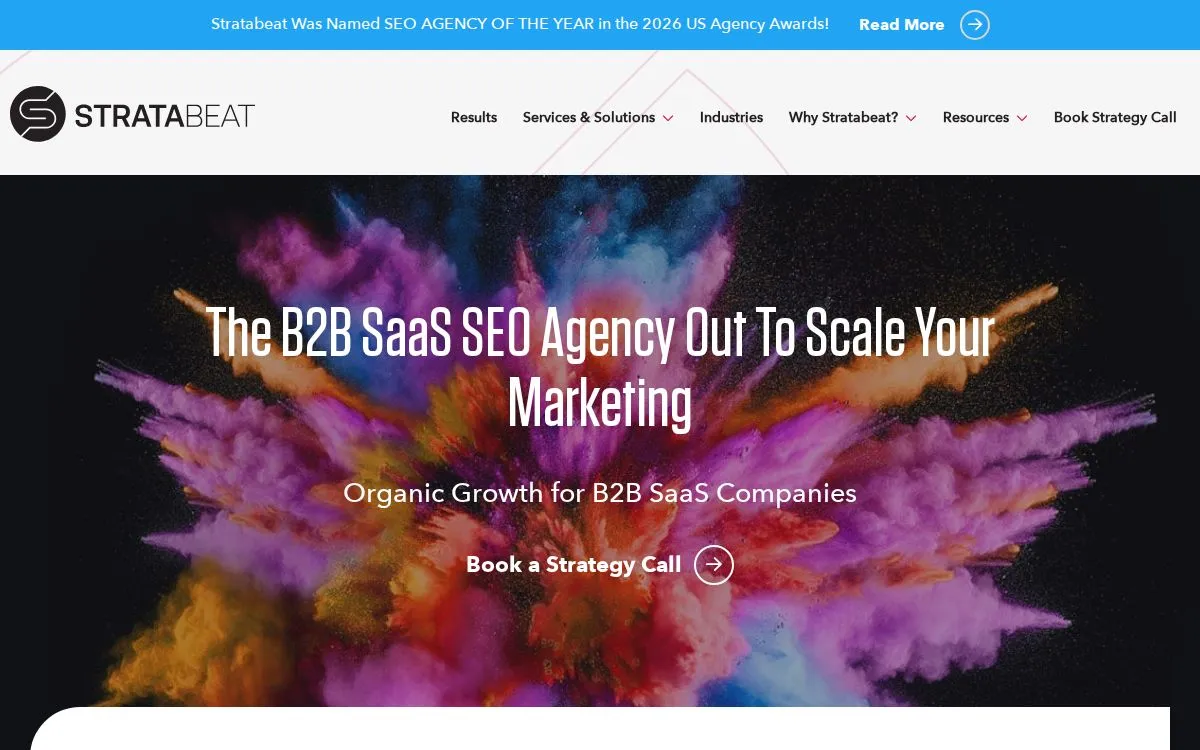
Who they are. A Massachusetts agency selling on accountability terms as much as tactics: transparent reporting, no long-term contracts, and conversion rate work attached to the SEO. [source]
Who they sell to (industries as listed by the agency): B2B SaaS, tech [source].
What the measurement says. The measured page uses 133 of the 307 market terms (43% coverage) over 3,254 words at 18.47% contextual density, repeating each term 3.12 times on average, its strongest pillar is efficiency at 96 and its weakest is footprint at 20, and it sits at position 31 on Google against 9 here, so the page is stronger than the domain carrying it.
What they say about themselves. Services listed: SEO strategy, content, conversion rate work, demo and trial signup growth [source]. No client names on the site. Pricing: no figure; states no long-term contracts [source]. One quantified claim, verbatim: “grew monthly organic traffic value by $682,088 for one client, who added 252 employees within three years; states B2B companies generate 2X more revenue from organic search than any other channel” [source].
Best for (our reading): B2B SaaS and tech marketers who want conversion rate work attached to the SEO, transparent metrics and no long-term contract.
10. Sure Oak
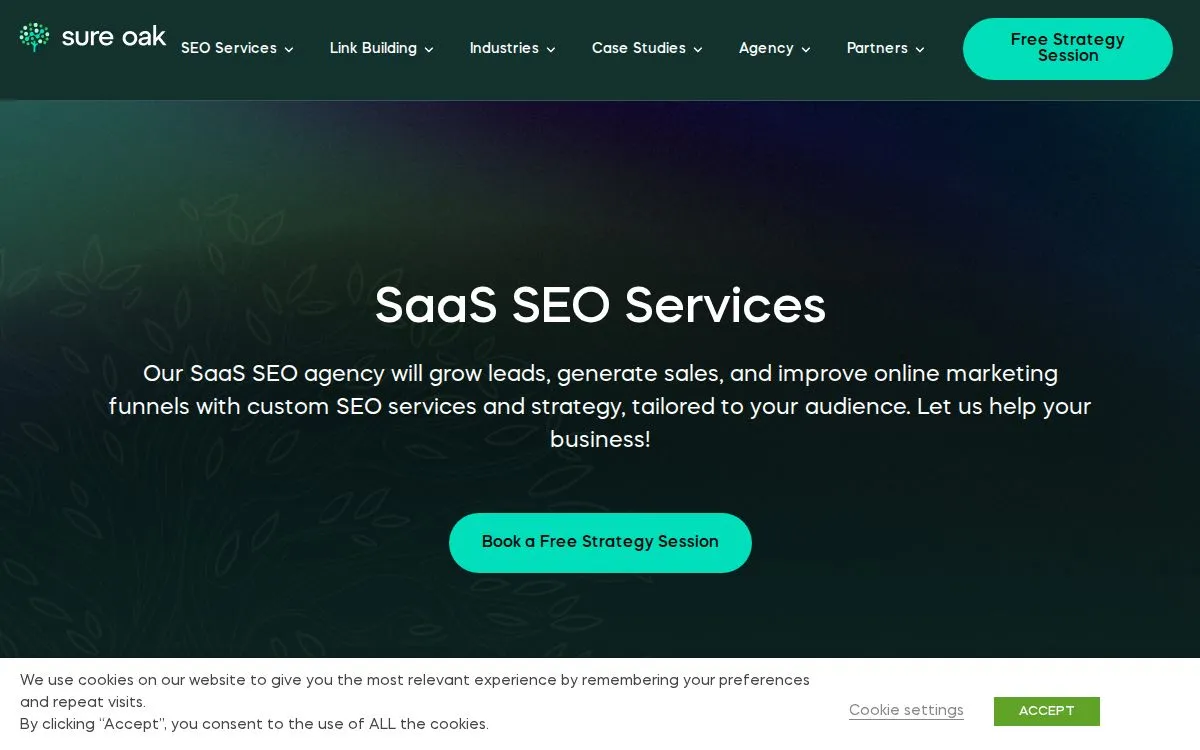
Who they are. A New York agency that files SaaS as one industry among several. The strongest brand demand in the cohort at 480 US searches a month, on the thinnest term coverage of the larger agencies. [source]
Who they sell to (industries as listed by the agency): SaaS, as one of several industries [source].
What the measurement says. The measured page uses 97 of the 307 market terms (32% coverage) over 2,483 words at 19.03% contextual density, repeating each term 3.23 times on average, its strongest pillar is efficiency at 93 and its weakest is structure at 10, and it sits at position 16 on Google against 10 here, so the page is stronger than the domain carrying it.
What they say about themselves. Services listed: B2B SEO services, SaaS SEO consulting [source]. No client names on the site. Pricing: not published [source]. One quantified claim, verbatim: “states SEO is 3X more likely to convert than PPC ads” [source].
Best for (our reading): SaaS companies wanting an established agency with the strongest brand search volume here and a broad b2b SEO services menu.
11. Virayo
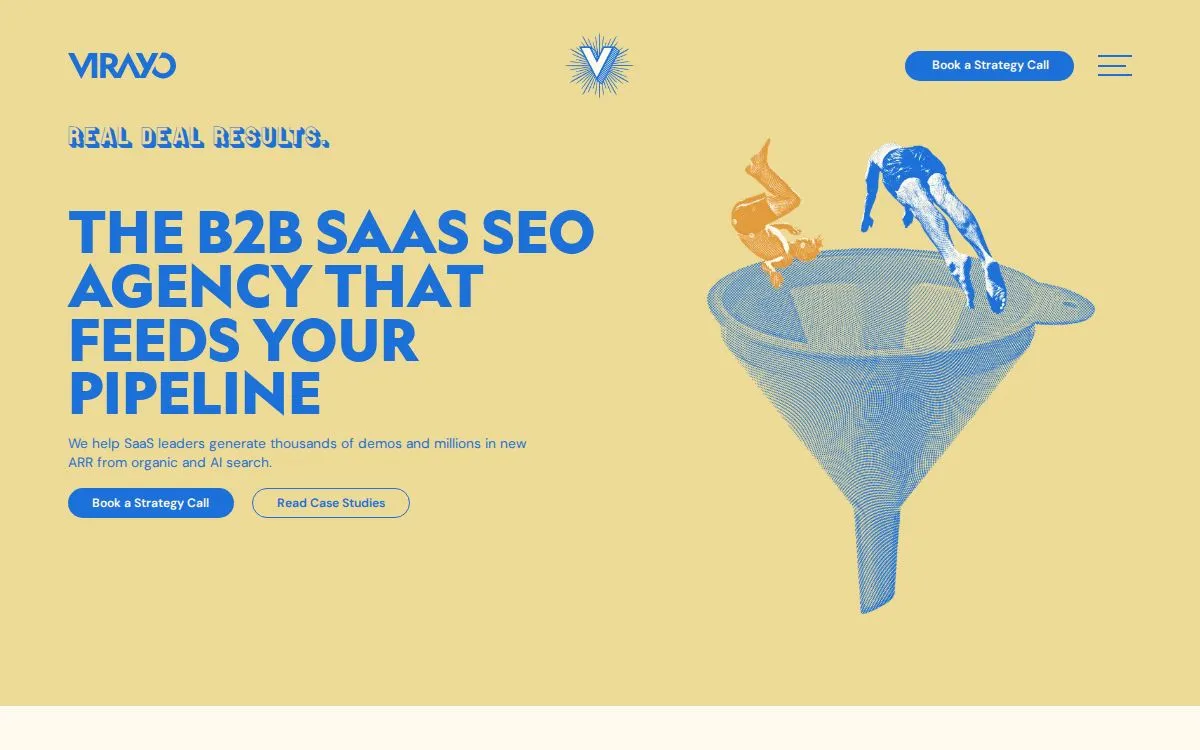
Who they are. A B2B SaaS specialist that gates engagements on budget and commitment, and frames the work around three surfaces: AI Overviews, review platforms and organic listings. [source]
Who they sell to (industries as listed by the agency): B2B SaaS, martech, salestech [source].
What the measurement says. The measured page uses 108 of the 307 market terms (35% coverage) over 2,650 words at 17.43% contextual density, repeating each term 2.91 times on average, its strongest pillar is efficiency at 100 and its weakest is structure at 19, and it ranks higher on Google (position 7) than on this index (11), which is the domain doing work the page doesn't.
What they say about themselves. Services listed: SEO strategy, AI Overviews and review-platform visibility, organic listings [source]. Clients named: ForUsAll [source]. Pricing: states a minimum of $7,500 a month for at least six months [source]. One quantified claim, verbatim: “organic search drives 48% of inbound sales qualified leads for one client; ForUsAll 6x qualified leads from organic search in 10 months” [source].
Best for (our reading): funded B2B SaaS companies with product-market fit that can commit $7,500 a month and want AI Overviews, review platforms and organic listings measured together.
12. Growfusely
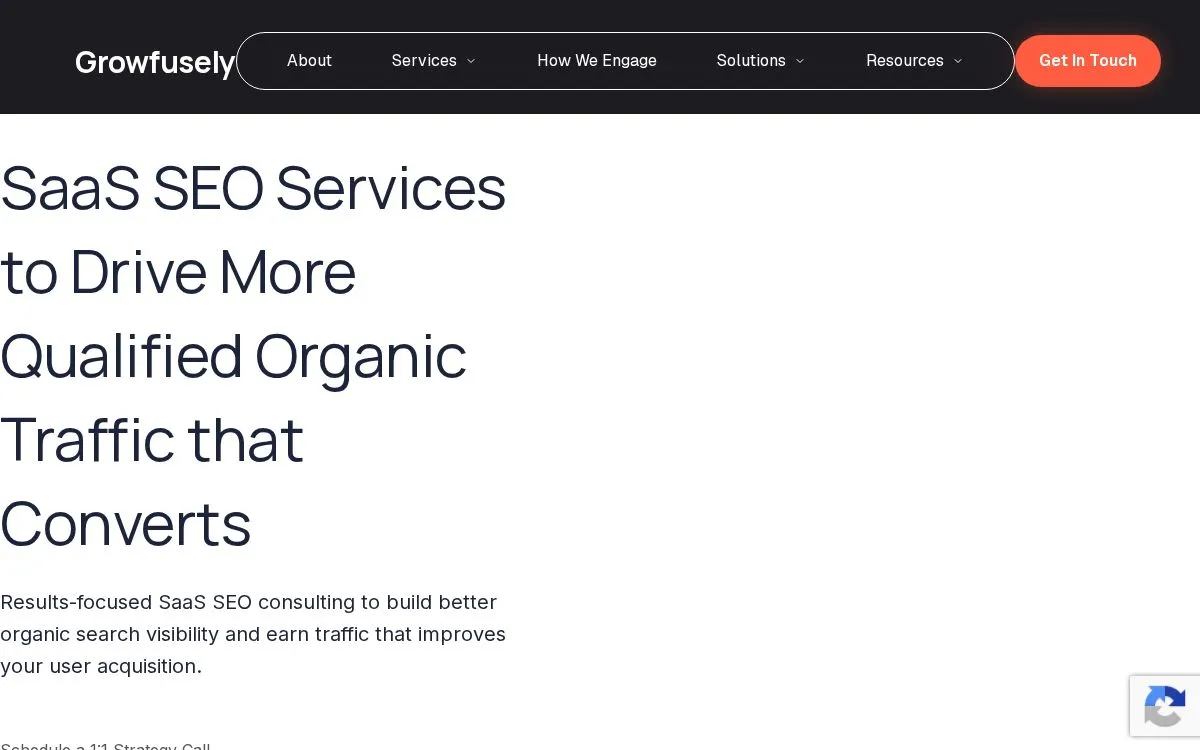
Who they are. A SaaS content and digital PR shop that sells consulting engagements rather than execution alone, and leads with the publications it has placed clients in. [source]
Who they sell to (industries as listed by the agency): SaaS brands [source].
What the measurement says. The measured page uses 112 of the 307 market terms (36% coverage) over 2,211 words at 21.14% contextual density, repeating each term 2.81 times on average, its strongest pillar is efficiency at 100 and its weakest is structure at 20, and it sits at position 38 on Google against 12 here, so the page is stronger than the domain carrying it.
What they say about themselves. Services listed: SaaS SEO consulting, content marketing, digital PR and link acquisition, pagespeed [source]. Clients named: Mind the Graph [source]. Pricing: a done-for-you monthly SEO retainer, no figure published [source]. One quantified claim, verbatim: “Mind the Graph organic traffic up 217% within six months; 217% qualified traffic growth and over twice the referring publications for a client” [source].
Best for (our reading): SaaS brands whose gap is content marketing for SaaS, digital PR and SaaS link building rather than technical work.
13. SaaS SEO
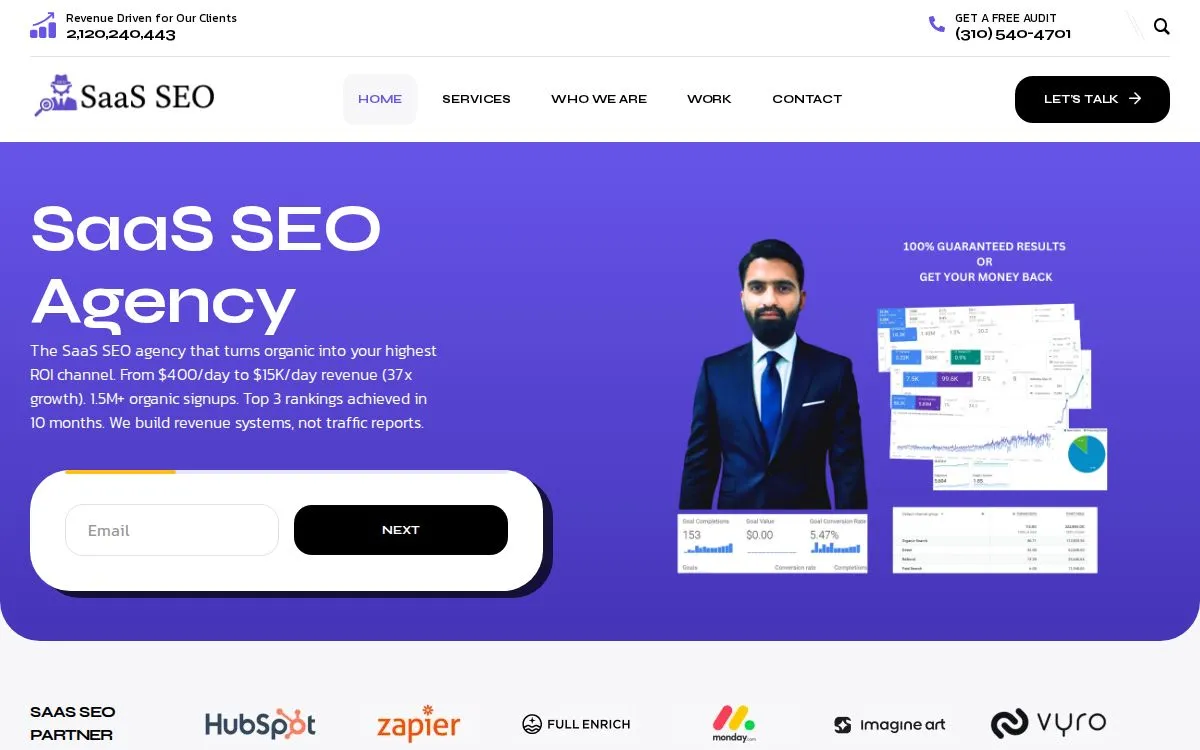
Who they are. A SaaS-only shop whose homepage is its service page. The site carries a trademark on the phrase SaaS SEO and presents one offer with no other vertical. [source]
Who they sell to (industries as listed by the agency): SaaS and software companies [source].
What the measurement says. The measured page uses 108 of the 307 market terms (35% coverage) over 1,659 words at 29.46% contextual density, repeating each term 3.52 times on average, its strongest pillar is efficiency at 85 and its weakest is footprint at 0, and it ranks higher on Google (position 1) than on this index (13), which is the domain doing work the page doesn't.
What they say about themselves. Services listed: SaaS SEO strategy, content, link building, technical SEO [source]. Clients named: HubSpot, Zapier, Monday.com [source]. Pricing: not published [source]. One quantified claim, verbatim: “From $400/day to $15K/day revenue (37x growth)” [source].
Best for (our reading): SaaS teams wanting one specialist shop with a single offer, a SaaS SEO strategy, content and backlinks, and no other vertical competing for attention.
14. SaaS SEO Agency
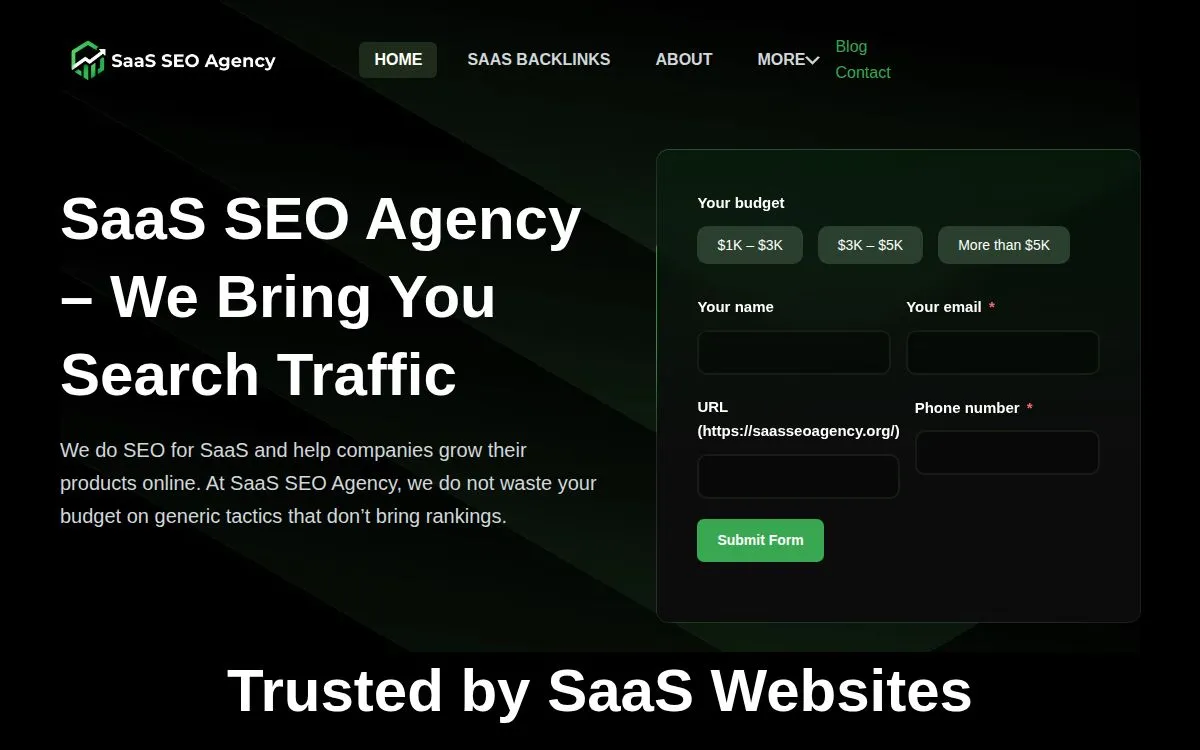
Who they are. The smallest page in the cohort at 788 words, and the only one publishing a price list on the service page itself. It sells fixed monthly plans rather than scoped engagements. [source]
Who they sell to (industries as listed by the agency): SaaS websites [source].
What the measurement says. The measured page uses 70 of the 307 market terms (23% coverage) over 788 words at 27.82% contextual density, repeating each term 2.33 times on average, its strongest pillar is efficiency at 100 and its weakest is footprint at 0, and it ranks higher on Google (position 2) than on this index (14), which is the domain doing work the page doesn't.
What they say about themselves. Services listed: SEO for SaaS, SaaS content writing, AI search optimization, technical SEO [source]. No client names on the site. Pricing: published tiers at $1,000 and $3,000 a month, billed monthly, one website each [source]. One quantified claim, verbatim: “counters for successful projects, organic traffic driven and average ROI increase all render as 0 on the live page” [source].
Best for (our reading): early-stage SaaS businesses wanting a fixed monthly plan with published pricing rather than a scoped SaaS SEO consulting engagement.
15. Groie
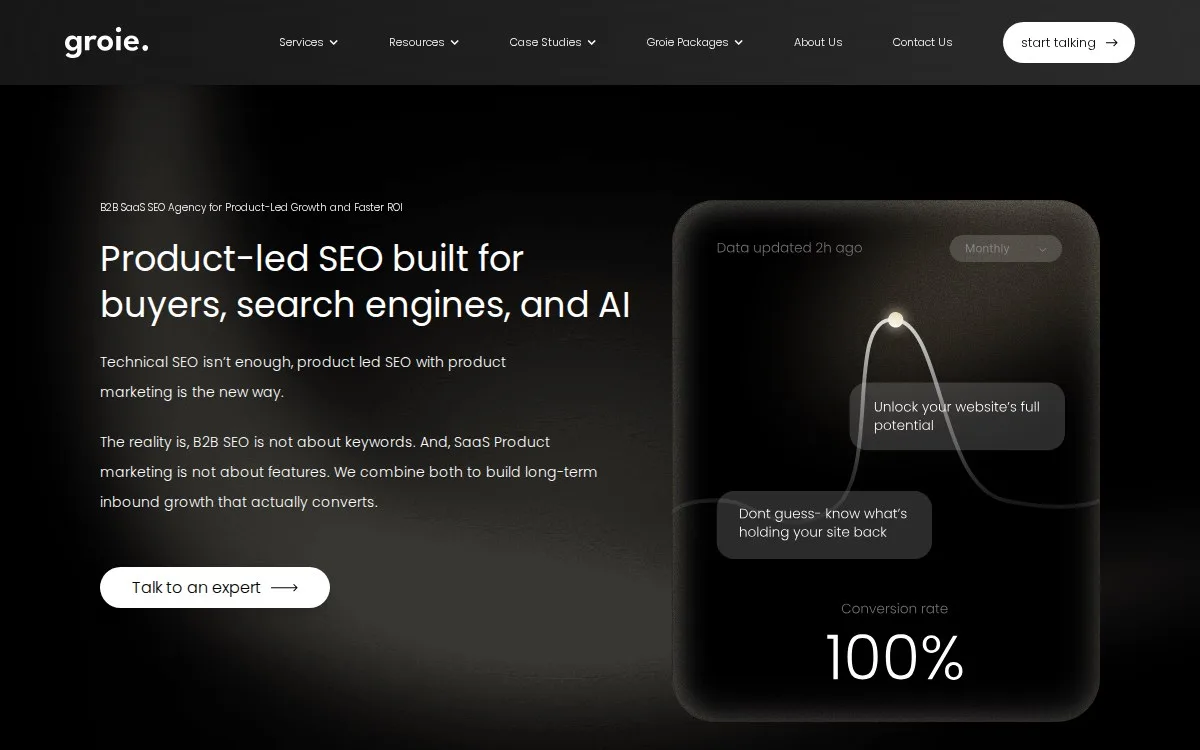
Who they are. The shortest full service page here at 1,027 words. It sells product-led SEO to seed and Series A founders and argues clarity over volume, including for how AI systems read a site. [source]
Who they sell to (industries as listed by the agency): early-stage B2B SaaS [source].
What the measurement says. The measured page uses 52 of the 307 market terms (17% coverage) over 1,027 words at 12.46% contextual density, repeating each term 1.71 times on average, its strongest pillar is efficiency at 100 and its weakest is footprint at 17.
What they say about themselves. Services listed: product-led SEO, product marketing, content pruning [source]. No client names on the site. Pricing: no figure; the page positions itself against bloated retainers [source].
Best for (our reading): seed and Series A founders who need product positioning and product-led SEO sorted before search visibility is worth chasing.
How to take first place on this table
The runner-up, OuterBox, sits 4.8 points behind. With every other pillar unchanged, closing that gap through coverage alone means covering 37 more of the 307 terms on the published list. The list, each term's document frequency across the cohort, the measuring script and its checksum are on the methodology page. Any agency on this table can request a re-measurement; the result is printed, with the date, whatever it shows.
How to choose a SaaS SEO agency
SaaS SEO is bought on pipeline and judged on organic traffic, and that mismatch is where engagements sour. Ask which metric the agency is accountable for, on what timeline, and how it reports SQLs, demo requests and trial signups rather than visitors. Four agencies here publish a retainer on the page, from $1,000 to $3,999 a month, and two more publish a range, so the investment is comparable before a call.
Product-led SEO and content SEO are different deliverables. Comparison pages, alternative pages, integration pages and feature pages are written inside the product's own vocabulary and often inside its own routes, and they answer high-intent search intent at the bottom of the funnel. An agency describing only content creation and link building is selling the second job, which may still be the right one for a company with no category competitors to compare against.
Technical work decides whether any of it ships. A SaaS marketing site, its app paths and its docs each crawl differently, so ask about crawlability, indexation, internal links, site architecture, schema and Core Web Vitals before you ask about a content strategy. OuterBox and ProStar SEO both lead with that order; several pages in this cohort treat technical SEO as a line item under content.
The AI search surface splits this cohort. Scalerrs, SimpleTiger and Briskon each name answer engine optimization or generative engine optimization as a service line, and Virayo frames its whole offer around AI Overviews, review platforms and organic listings. Ask what is measured there, because citations in ChatGPT, Gemini and AI Overviews are countable, and a claim of AI search visibility without a number is a position rather than a service.
Agency size predicts little and specialization predicts more. OuterBox states 300+ staff and measures first. Groie runs 1,027 words for seed-stage founders and measures last. Both are coherent offers for different SaaS businesses. Ask who holds your account and what else they hold, then check the agency's own page-one keywords and AI Overview citations in the table below against the track record it claims.
Questions to ask a SaaS SEO agency before hiring
Which metric are you accountable for, and on what timeline? The answer names one number and a date. A SaaS SEO agency answering with organic traffic alone has committed to nothing a finance team recognizes. Pipeline impact, SQLs and demo requests are the measures that survive a budget review.
What is your monthly retainer, and what are the deliverables? The answer is a figure and a scope. Six of the fifteen publish a price or a range in public, so the question is fair to ask the other nine, and it separates a SaaS SEO consultant from a full execution team.
What happens in the technical SEO audit, and who fixes what it finds? The answer covers crawl budget, indexation, internal links, site architecture, page speed and Core Web Vitals, and it says who deploys the fixes. Recommendations nobody ships are not a deliverable.
What do you do about comparison, alternative and integration pages? The answer describes page types, who writes them and who deploys them. This is the work that separates product-led SEO from content marketing wearing a SaaS label.
How do you measure visibility inside AI answers? The answer names tracked prompts or competitors and a number. Generative engine optimization is measurable, so a claim of AI search visibility with no measurement behind it is a position, not a service.
How these SaaS SEO scores are read
Five pillars make the score and four measure the page. Coverage counts how many of the 307 market terms the page uses. Density passes contextual density through a saturation curve. Efficiency reads the repetition index and gives full marks at 3 or below, where density comes from breadth rather than repetition. Structure reads how many covered terms reach a title tag, an H1, an H2 or an H3. Footprint is the one pillar that is not the page: United States brand search volume averaged against Google review standing.
The term list matters because coverage is only as honest as its list. The 307 terms are two sets: every Semrush broad-match variation of "saas seo agency" at ten or more US searches a month, with geographic, brand-name, year-dated and conversational queries removed; and the vocabulary the fourteen competitor pages share, extracted statistically and kept where two or more carry a term. ProStar SEO's page played no part in building either set.
Our own row asks for a note, because this section sits on the page it scores. The vocabulary in these profiles and tables counts toward ProStar SEO's own measurement, so the row was computed from a live re-measurement of this published page and not from a draft. ProStar SEO also does not appear in the forty-five captured results for the anchor keyword, so the position column prints a dash instead of an estimate. A reader who wants the page read without the section can subtract it: the service copy alone measures 16.02% density on 3,241 words.
The instrument is in good health. Of the 307 terms, 237 are carried by some competitor pages and not others, and only two appear on every one, so the list separates this cohort rather than handing every row the same points. Sixty-eight terms appear on no competitor page at all. Live SERP position is printed and scored by nothing: SaaS SEO sits at position one while measuring twelfth, and those two facts are allowed to disagree, because the index reads what a page says and a position reads everything Google weighs.