
They're talking about us




The Engines We Measure, and What Each One Rewards
AI search engines do not share one ranking system. ChatGPT builds answers from its own index and from Bing. Google AI Overviews and Google AI Mode build answers from Google’s index. Perplexity cites sources in the body of the response. Claude, Microsoft Copilot and Meta AI each assemble answers from a different mix of retrieval and training data. An AI SEO agency that treats these generative engines as one surface will report a number that hides more than it shows.
We measure each platform separately. Our team runs a fixed prompt set against ChatGPT, Perplexity, Gemini and Google AI Overviews, records every brand that appears, and records which URL the engine cited. The same prompts run each month, so the movement is comparable. ChatGPT visibility and Perplexity visibility are reported as separate lines, because a brand can hold one and lose the other for reasons that have nothing to do with the page.
The pattern we see across accounts is consistent. LLM platforms reward pages that answer a question in full, in one place, with the entities named. Traditional search rewards pages that match a query. The two overlap, and the overlap is where structured content earns both. A page that is easy for AI crawlers to parse, that carries structured data schema, and that states its claims as complete sentences rather than fragments, gets referenced by AI systems and ranked by search engines at the same time.
Answer engines behave differently again. An answer engine optimization brief targets the short, factual response: definitions, comparisons, prices, steps. AEO answer engine work is narrow and it is measurable. Generative engine optimization is broader, because generative engines summarize rather than quote, and a brand earns its place in the summary through repeated association with the topic rather than through a single well-placed sentence.
Contextual Density: The Method Behind Our AI Search Rankings
ProStar SEO built contextual density to answer one question: what separates a page that ranks from one that does not? The method is published. Audit it, argue with it, run it against us.
The Contextual Density Formula
Contextual Density = (Keyword variations + Relevant entities + LSI terms) / (Total words – Stop words) x 100Where:
- Keyword variations include synonyms, plurals and related phrases
- Relevant entities are terms with established recognition: brands, locations, platforms, concepts
- LSI terms supply the surrounding context of processes, techniques and outcomes
Exact-match keyword density stopped being a useful dial years ago. Breadth replaced it, and our write-up of contextual density carries the correlation data behind that claim.
Why Contextual Density Works for Both Search Engines and LLMs
Search engines and LLMs parse natural language with related machinery, and both reward coverage that is broad and specific at once. A page carrying 80 distinct relevant terms signals topical command. A page repeating six terms forty times signals nothing.
Semantic diversity is how we count the difference. In our correlation work, distinct entities and unique LSI terms track rank position more closely than raw repetition, which sits near zero. Topical authority follows from that breadth. The finding is correlational and we say so to clients.
Breadth beats frequency. Every time we have measured it.
Unique Contextual Density, Repetition Index and Entity Salience
Contextual density alone can be gamed by repetition, so three numbers sit beside it. Unique contextual density counts distinct terms rather than occurrences. The repetition index is the ratio between the two, and it says whether a page earned its score through breadth or through saying one thing eleven times.
Entity salience is position. An entity used as a sentence subject outweighs the same entity in a parenthetical, and natural language processing in search engines and LLMs is sensitive to that.
Placement is measured again on its own. Terms in the title tag, in the H1, H2 and H3 layer, in internal links and anchor text, and in alt text attributes correlate with rank position more strongly than the same terms in a paragraph. Semantic link clusters do this at site level, where entity signals repeated across linked pages resolve faster than one page asserting everything alone.
Underneath the prose we write RDF semantic triples. Subject, predicate, object, stated plainly. Training data taught these models what a factual sentence looks like, and copy shaped that way survives chunk retrieval intact.
Why AI Search Visibility Is Worth Budget Now
The traffic shift is real, though published figures vary by study and age quickly. What follows is dated on purpose.
AI Referral Traffic, Conversion Rates and Zero-Click Search
Semrush’s 2025 study found AI search visitors converted at roughly 4.4 times the rate of average organic search visitors. Ahrefs reported AI search referrals to retail sites rising 1,300% across the 2024 holiday season. Search Engine Land documented generative AI referral traffic growing 123% between September 2024 and February 2025.
Conversion rate carries the argument, not volume. AI referral traffic stays small against organic traffic for most sites, and arrives further down the funnel.
What Changes for Your Organic Traffic and Google Rankings
Zero-click behavior expands where AI Overviews appear. Accelerated Digital Media measured organic click-through rates falling from 1.41% to 0.64% on queries showing an AI Overview. Your Google rankings can hold while clicks decline, which is the case for giving AI visibility its own reporting line. Ranking reports alone will not show it.
Talk to an AI SEO Specialist About Your Vertical
Regulated industries move differently, and we work in most of them. Cannabis, casino, legal, dental, healthcare, firearms.
Measured AI Visibility: What 38 Prompts Say About This Agency
Most AI SEO agency pages claim AI search expertise and then prove it with organic traffic charts. We point the AI visibility audit at our own brand and publish what it returns, the same measurement our AI SEO services run for clients.
The instrument is a fixed set of 38 commercial prompts, the kind of question a buyer actually types when they’re looking to hire: best agency for a given industry, best agency in a given country, who to use for a particular kind of site. The set spans cannabis, firearms, plastic surgery, casino and iGaming, hotels and crypto, and it runs in the United States, Canada and France.
We don’t publish the prompts themselves, for the same reason no agency publishes its keyword list. We do publish what comes back.
ZeroRank runs that set against four answer engines on a schedule and records which brands the AI-generated answers name: ChatGPT, Gemini, Google AI Mode and Google AI Overviews. Bing Copilot and ChatGPT Web Search aren’t enabled on this account, so nothing here speaks to those two AI platforms. The figures below cover September 16 to 22, 2026 and rest on 5,665 recorded citations.
Three numbers per brand, all non-branded. AI visibility is the share of tracked chats whose answer mentions it at all, the citation share figure our reporting calls prompt coverage. Rank is its average position inside the AI search results when it does appear. The sentiment score reads how favorably the cited sources describe it, 0 to 100.
ProStar SEO Against Coalition Technologies, Thrive and the Field
| Brand | Visibility | Sentiment | Avg. rank in answer |
|---|---|---|---|
| ProStar SEO | 24% | 74 | 2.7 |
| Coalition Technologies | 16% | 79 | 3.0 |
| SEOProfy | 11% | 77 | 3.1 |
| Loopex Digital | 10% | 79 | 3.2 |
| 1Digital Agency | 9% | 80 | 2.7 |
| Thrive | 8% | 75 | 3.7 |
| Dutchie | 8% | 50 | 6.9 |
| Ninja Promo | 6% | 75 | 3.4 |
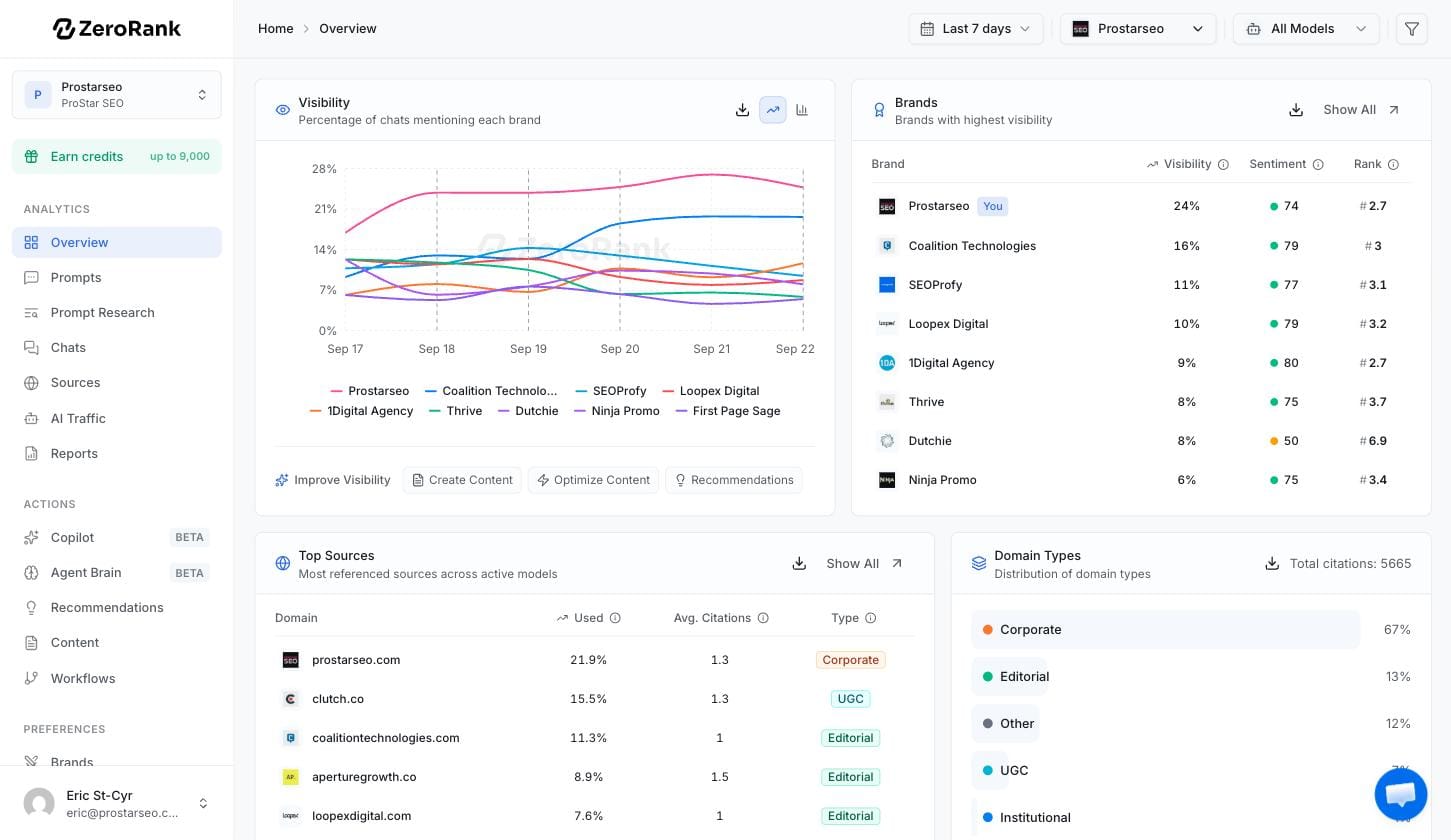
Our brand mentions reach 24% of tracked chats. Coalition Technologies, the nearest AI SEO company in the set, gets 16%. Thrive gets 8%. That’s half again as often as Coalition and three times as often as Thrive, on the same prompts, in the same week, on the same instrument. Competitor analysis and our own share of voice come out of one run rather than two.
Average rank matters as much as mention rate and gets reported less often. Ours is 2.7, tied with 1Digital Agency for the best in the table, so when a large language model names us it tends to name us early rather than fourth on a list of eight. Coalition sits at 3.0 and Thrive at 3.7.
Both numbers go on the same dashboard line. AI citations that arrive at position seven convert like rankings that arrive on page two.
One column doesn’t go our way. The sentiment score is 74, and five of the seven tracked competitors score higher, 1Digital Agency highest at 80. Sentiment reflects what the cited sources say about a brand rather than how often they say it, so the fix is reputation management and review platforms rather than retrievability, structured data or entity signals. We report it because leaving it out would make the rest of the table less believable.
The Same Prompts, Broken Out by Platform
Averaging four AI engines into one score hides more than it shows, which is why our AI visibility reporting stays per platform. Here’s the same week, one model at a time.
| Model | ProStar SEO | Coalition Technologies | Thrive | Citations |
|---|---|---|---|---|
| Google AI Overview | 37% | 21% | 12% | 810 |
| Google AI Mode | 31% | 19% | outside top 8 | 968 |
| Gemini | 23% | 22% | 11% | 1,229 |
| ChatGPT | 11% | outside top 8 | outside top 8 | 2,658 |
On Google’s three generative search surfaces we lead all three, and on AI Overviews we hold nearly twice Coalition’s citation share and three times Thrive’s. On Gemini the margin is one point, close enough that a fortnight of monitoring could read it either way.
ChatGPT is the honest exception. There our LLM visibility sits at 11%, level with SEOProfy rather than ahead of the field, on the largest citation base of the four AI platforms. Coalition and Thrive don’t reach the top eight in those AI search results at all, so the ChatGPT market has a different shape and a different set of names in it.
That split is what you’d expect from how contextual density was built. The method came out of measuring what ranks in Google search, so it transfers first to the answer engines drawing on Google’s index and infrastructure, where topical authority and E-E-A-T signals carry the same weight they carry in organic search. ChatGPT sources differently through Bing, and the AI SEO strategies that move it are partly different work.
Why the Size of the Agency Isn’t Deciding This
An easy explanation for an AI search visibility gap is that the bigger agency wins. The countable inputs say otherwise here.
| Referring domains | Total backlinks | |
|---|---|---|
| Thrive | 13,471 | 239,320 |
| Coalition Technologies | 5,613 | 68,744 |
| ProStar SEO | 1,458 | 88,144 |
Thrive links from roughly nine times as many distinct domains as we do. Coalition links from close to four times as many. Both get named by the answer engines less often than we do, and both sit behind us on average position inside the AI-generated answers. Link building moves search engines. It is not, on this evidence, what decides AI visibility.
We don’t use vendor authority scores to explain any of this, ours or theirs. Every tool invents its own, they disagree with each other, and at least one takes organic traffic as an input, which makes citing a low score to explain weak visibility an argument in a circle. Referring domains and backlink counts are countable, so those are the ones on the table.
What’s left as an explanation is the page text. Our AI SEO services write every page against a measured term list extracted from whatever currently ranks, with contextual density and semantic diversity targets set above the best page in that set rather than against a house style guide. Answer engines quote passages. A page carrying more of a subject’s keyword variations, entities and LSI terms, in sentences a model can lift whole, gives them more to quote.
Where the Citations Actually Come From
| Source | Share of tracked chats | Avg. citations per chat |
|---|---|---|
| prostarseo.com | 21.9% | 1.3 |
| clutch.co | 15.5% | 1.3 |
| coalitiontechnologies.com | 11.3% | 1.0 |
| aperturegrowth.co | 8.9% | 1.5 |
| loopexdigital.com | 7.6% | 1.0 |
Corporate domains supply 67% of the citations in this market, editorial 13%, UGC 7%. Our own site is the most-cited source in the set at a citation frequency of 1.3 per chat, which is the position you want and not one most AI SEO agencies hold in their own market.
Clutch is the interesting line. It supplies about a sixth of the AI citations here, and the specific Clutch pages doing the supplying are its SEO firms category and its industry lists. We’re not named on most of them. That’s a gap in our own AI visibility, sitting in our own monitoring, and directory and review platform work is the next thing on the roadmap rather than something we’d rather you didn’t notice.
See the Same Measurement Run on Your Market
We build the prompt set from your commercial queries and your Google Search Console data, run it across the same four engines, and hand you the table above with your brand in it and your competitors beside it. The free AI SEO audit includes the raw prompt logs. No contract, and the measurements stay yours whichever way you decide.
Get Your Free AI Visibility Audit
Figures measured September 16 to 22, 2026 across 38 prompts and 5,665 citations. Answer engines change retrieval behavior without notice, responses vary by location and phrasing, and this table is recomputed monthly rather than frozen.
Our AI SEO Process: Audit, Build, Monitor
Eight weeks to a working baseline, then continuous operation. One AI SEO strategy, adjusted per vertical: the sequence below is the same for a SaaS company and a dental group, and only the prompt set and the vertical entities change.
Weeks 1 to 4: Technical Foundation and Schema Markup
We open with a full audit: current rankings, AI visibility, crawler access, and contextual density measured against your live competitors. Gap analysis produces the build list.
Technical work follows immediately. Schema markup deployed, Core Web Vitals addressed, indexing errors cleared through Google Search Console, internal linking restructured so authority reaches the pages you want cited.
Weeks 5 to 8: Content Optimization and Authority Signals
Content optimization runs against the measured term instrument, not against a writer’s instinct or a generic SEO strategy. We build topic clusters, rewrite thin pages, and add the statistics, original research and expert quotes that give a model something quotable. Structured answers go first in each section. Comparison pages and listicles get their own treatment, because assistants pull from them constantly.
Authority signals build in parallel: digital PR, press distribution, reviews and testimonials on the platforms your buyers check, and link building services aimed at genuinely relevant domains. Backlinks still carry retrieval weight.
Content strategy and content marketing stay inside the same instrument rather than running beside it. Every brief carries the measured term list, and the pages that earn AI citations are the ones built to be quoted rather than skimmed.
Ongoing Monitoring, Reporting and Prompt Volume Tracking
Monitoring never stops. We rerun the prompt set on schedule, track brand mentions across platforms, and log which competitor displaced you when a citation moves. Reporting arrives monthly through a dashboard with the raw prompt logs attached, so you can verify every number yourself. First-party data from your CRM closes the loop between a citation and a signed contract.
Three things run on the monthly cycle. Prompt testing rebuilds the set as your buyer questions change, prompt coverage tracks what share of it you appear in, and share of model measures how much of the answer space you hold against named competitors. Non-branded figures only. A company’s own name inflates every visibility metric and hides whether the work is doing anything.
AI crawler log analysis sits alongside it. Server logs show which bots actually fetched which pages and how often, which is the only direct evidence that your answer-ready content reached the index at all. Page speed and on-page SEO hygiene stay on the same report, because a page a crawler abandons is a page no model can quote.
Request an AI SEO Reporting Walkthrough
See the actual report before you sign anything. Month to month, no long-term contract, cancel with 30 days’ notice.
We also track the sources the engines cite when they answer without naming us. Knowing which competitor, directory or review page an engine trusts on a query tells us where the authority sits, and it turns a vague visibility problem into a list of specific pages to earn a mention on. That analysis produces the digital PR and entity topic clusters work in the following quarter. It is the difference between guessing at brand authority and reading it off the answers themselves.
Measuring AI SEO Beyond Rankings
Two metric families, reported side by side. Neither one alone tells you whether the program works.
Visibility Metrics: Brand Mentions, Share of Voice, Citations
Four numbers make the visibility panel:
- Brand mention frequency across AI responses
- Query coverage against the full prompt set
- Share of voice measured against named competitors
- Position within each AI-generated recommendation list
Citation share is the headline number, and we report it per platform rather than blended.
Keywords still appear in this reporting. They anchor the prompt set and keep the AI layer connected to the local SEO services and organic work running underneath it.
Two numbers sit underneath those four and get reported per platform. Citation frequency counts how many times a source is quoted inside a single answer, which separates a passing mention from a page the model leans on. Sentiment score reads how favorably the sources describe you, 0 to 100, and it moves on reputation management rather than on entity optimization or any other technical fix.
We also log whether your page supplied the direct answer or merely appeared in the source list underneath it. Those are different outcomes and most AI SEO agencies report them as one.
Business Metrics: Leads, Conversion Rate and ROI
Visibility that produces nothing is a vanity metric. We report traffic from AI-referred sources, lead quality, conversion rate movement, and ROI against spend. Every ProStar SEO case study reports both. Our SEO case studies show the format.
Revenue is the number that ends the argument. We report AI-referred sessions, assisted conversions, qualified traffic against total traffic, click-through rate movement on the queries where an AI Overview now sits, and conversion rate optimization results on the landing pages those visits reach.
Buyer journey stage matters here. AI-referred visitors arrive later than search visitors, which is why their conversion rate reads higher on a smaller volume. Brand visibility that produces no pipeline is a chart, not a result.
We publish a ranked comparison of this market rather than asking you to take our word for it. See the 15 best AI SEO companies of 2026, ranked by the SEO Contextual Density Index, where ProStar SEO is measured on the same instrument as every other agency and placed at its real rank.
Hiring an AI SEO Agency, an AI SEO Consultant, or Building In-House
Most businesses asking about AI visibility optimization are choosing between three routes, and the right answer depends on how much of the work is one-time.
An in-house team owns the context. Your specialists already know the product, the buyers and the competitive set, and they can move without a briefing cycle. The cost is instrumentation. Tracking AI search requires a prompt set, a citation tracking system, and someone to run it every month. Most in-house teams can do the content optimization and cannot justify building the measurement layer for one brand.
An AI SEO consultant is the cheapest way to buy a diagnosis. A consultant will audit the site architecture, name the gaps and hand over a roadmap. The limit is delivery. A roadmap that nobody implements does not change what an AI assistant says about you.
An AI SEO agency carries both. AI SEO companies that do this properly own the implementation and the measurement, and they report against a baseline they recorded before the work started. That is the part worth interrogating when you compare providers. Ask any AI SEO agency for the before number. If the answer is a promise rather than a measurement, the engagement has no way to prove impact.
Scale decides the rest. A single-location business with a narrow service list can reach most of the available opportunities in one quarter. A brand with a large site, several product lines and multiple markets needs a campaign that runs continuously, because the surface keeps moving. We size the work to the site, not to a package. AI SEO services agency pricing that ignores the size of the site is pricing a guess.
AI SEO Agency FAQs
What does an AI SEO agency actually do?
An AI SEO agency makes your brand retrievable and quotable by large language models. LLM SEO services and AI-driven SEO describe the same scope under different names. The work covers technical access, structured data, entity clarity, content written for extraction, and third-party citations. It runs alongside conventional SEO rather than replacing it.
How is AI SEO different from traditional SEO?
Traditional SEO optimizes for position in a list of search results. AI SEO optimizes for inclusion inside a generated answer. Ranking first helps but does not guarantee citation. AI search results select passages, evaluate source authority, and often cite pages ranked below the top organic result.
Which AI platforms do you optimize for?
ChatGPT, Google Gemini, Google AI Overviews, Perplexity, Claude and Microsoft Copilot. Coverage differs by platform because their retrieval sources differ, so AI-powered SEO reporting has to stay per-platform. We report each one separately rather than averaging them into a single score.
Google’s own naming has moved more than once. What launched as the Search Generative Experience became AI Overviews, and SGE still appears in older documentation and in plenty of agency decks. Artificial intelligence sits under all of it, and the AI-powered platforms a buyer names in a brief rarely map cleanly onto the engines that actually answer their customers.
AI search optimization is the label we use for the whole program. AI-generated answers are what it targets.
Do keywords still matter for AI SEO?
Yes, with a change of role. Keywords define the prompt set and keep your pages retrievable in the search indexes that feed most assistants. Distinct variations and entities do more work than repetition of a single phrase.
Should we block AI crawlers like GPTBot?
Blocking GPTBot removes your content from the corpus that answers questions about your industry. Publishers negotiating content licensing deals sometimes have a reason to block. For a business that wants to be recommended, blocking is self-defeating.
How long does AI SEO take?
First citation movement typically appears in 60 to 90 days after the technical and content work ships. Meaningful share-of-voice change takes 6 to 12 months. Anyone promising faster is guessing.
What is the difference between GEO, AEO and LLM SEO?
Generative engine optimization, usually written GEO, targets the summaries that generative engines produce. Answer engine optimization, or AEO, targets direct factual answers. LLM SEO is the broader label for both, plus the technical work that lets a large language model read the page at all. In practice the three overlap heavily and most GEO optimization briefs contain AEO work. Some agencies market the same service as generative SEO, AI content optimization, model optimization or language model optimization. The labels differ, the work does not differ much.
Do you offer AI overview optimization separately?
Yes. AI overview optimization is a distinct engagement because Google AI Overviews draw from Google’s own index, so the ranking work and the citation work reinforce each other. Brands that already rank on page one for a query win the AI Overview citation more often than brands that do not. For that reason we do not sell AI overview optimization as a replacement for traditional search work. We sell it as the layer on top.
How do you report AI visibility?
Every account gets a monthly report with three blocks. Visibility tracking shows the share of prompts where the brand appeared, by engine. Content visibility shows which of your pages the engines cited, so you can see whether the citations land on the pages that convert. AI traffic shows referral sessions from AI assistants in your analytics, separated from organic. The report names what moved and what did not.
Can you work alongside our existing SEO agency?
Often, yes. Where another agency owns the content calendar, we run the AI visibility audit, the schema and entity work, and the measurement, and we hand the content recommendations to them. Splitting the work this way is common with in-house teams that already have a content function and want the AI layer added without changing suppliers.
Work With an AI SEO Company That Publishes Its Method
ProStar SEO has operated as an LLM SEO agency since 2019, from Quebec, Montreal, Toronto and Calgary, in French, English and Spanish. The contextual density method is public. The measurement scripts are the same ones we run on your competitors.
Every Industry, One Instrument
The method holds across verticals because it measures coverage, not category. Healthcare providers, surgical practices running plastic surgery SEO, SaaS and fintech platforms, ecommerce catalogs, B2B services, local trades and manufacturers all get the same instrument pointed at a different term list, whatever the AI SEO marketing label on the proposal says. Ecommerce catalogs feed AI shopping surfaces through product structured data, and Shopify emits that data from theme templates, so Shopify SEO starts in the theme rather than in the individual listing. Our enterprise SEO agency work and our international SEO consultant practice extend it across markets, where entity clarity per locale decides whether a model describes your brand the same way in every language.
Restricted verticals are where the method gets tested hardest. Paid channels are closed to a cannabis SEO company and to casino operators, so answer-engine citation is one of the few acquisition surfaces left open, and the same pressure applies in real estate SEO, where buyers now ask an assistant to shortlist agents before they open a portal. Where the answer still resolves locally we read the map pack with a local SERP checker rather than trusting a national average.
Franchise and multi-location brands get one more layer, because a model has to resolve which location it is describing before it can recommend one. Our AI SEO methodology is the same document whether the engagement is called AI SEO services, AEO, GEO or answer engine work, and the AI SEO framework behind it has not changed since we published it. What changes between accounts is the term list and the prompt set.
The wider digital marketing program feeds the same signals. Thought leadership placements, review platforms like Clutch and G2, and YouTube content all supply the third-party citations that answer engines pull from, and a data-driven agency should be able to show you which of those actually moved its mention rate. Ours are in the table above.
What a Free AI SEO Audit Includes
The free proposal is the measurement, run on your market before you have paid anything: your contextual density and coverage figures against the pages currently ranking, your AI visibility baseline across the platforms we can reach, your crawler access and structured data state, and an AI SEO roadmap ordered by what moves first. It is the same AI SEO audit our own team runs internally, on the same scripts.
Target audience definition happens in that session too, because the prompt set is only as good as the buyer questions behind it, and user experience issues that suppress retrievability get flagged in the same pass. You keep the document whichever way you decide. Several of the agencies that call themselves the best AI SEO agency will not show you a measurement before a contract. That is a choice they made about their numbers.
What We Do Not Promise
We do not promise a fixed position in an AI answer. Nobody controls that. Platforms change ranking behavior without notice, responses vary by location and phrasing, and no vendor has an API for guaranteed inclusion.
What we commit to: accurate information, documented method, compliance with platform guidelines, and month-to-month billing.
If an agency guarantees you a spot in ChatGPT, ask them to put it in the contract.
Schedule Your Free AI SEO Consultation
No contract, no obligation, and a free audit of your current AI visibility. Thirty minutes tells you whether there is work worth doing.